1. Executive Overview: The Mechanics of Modern Indexing Velocity
In modern digital commerce and search engine optimization, publication speed is directly tied to business revenue. Whether launching high-frequency news updates, publishing programmatic directory pages, rolling out extensive e-commerce catalogs, or deploying technical blog articles, the delay between content publication and search engine indexation represents lost revenue and lost organic traffic. A modern fast indexing tool addresses this fundamental gap by systematically accelerating how search engine crawlers discover, retrieve, and index newly deployed URLs.
Historically, webmasters relied on passive discovery models: publishing an article, adding the URL to an XML sitemap, and waiting for search engine crawlers to discover the update during periodic crawl sweeps. In contemporary web ecosystems containing billions of active documents, this passive model frequently results in latency of several weeks. Googlebot and Bingbot must triage computational resources across massive digital networks, often ignoring fresh URLs on non-tier-1 websites unless an explicit, authenticated crawl trigger is broadcast.
Fast indexing platforms bridge this latency gap by deploying multi-vector crawl acceleration. By integrating direct search engine API webhooks, IndexNow protocols, distributed ping clusters, and edge cache warming, an enterprise fast indexing tool can compress the standard indexation window from fourteen days down to fewer than twenty-four hours. This architectural guide provides an in-depth examination of search bot dispatch mechanics, server response tuning, programmatic sitemap hygiene, and real-time log forensics designed for technical SEO directors, web architects, and engineering teams.
A. The Direct Link Between Indexation Velocity and Competitive Market Advantage
In fast-moving commercial verticals such as financial market analysis, breaking consumer news, high-turnover real estate inventory, and seasonal e-commerce drops, search visibility carries a strict expiration window. If a real estate portal publishes 500 new apartment listings in a high-demand urban market, but search engine spiders do not discover and index those URLs for twelve days, potential buyers will discover those properties on rival portals that achieved indexation within hours. Achieving rapid crawl throughput is not merely an engineering benchmark; it is a primary driver of commercial customer acquisition and search visibility.
B. The Computational Cost of Crawling the Modern Web
The global web expands by millions of new documents every hour. Search engine infrastructure, while vast, operates under finite physical constraints: data center electricity consumption, server rack capacity, network bandwidth, and memory storage. Consequently, search engines have replaced indiscriminate web crawling with sophisticated mathematical models that calculate the expected economic and informational value of crawling any specific domain. To earn frequent, high-priority crawl attention, webmasters must demonstrate that their servers respond instantly, that their technical architecture is pristine, and that their update signals are verifiably authentic.
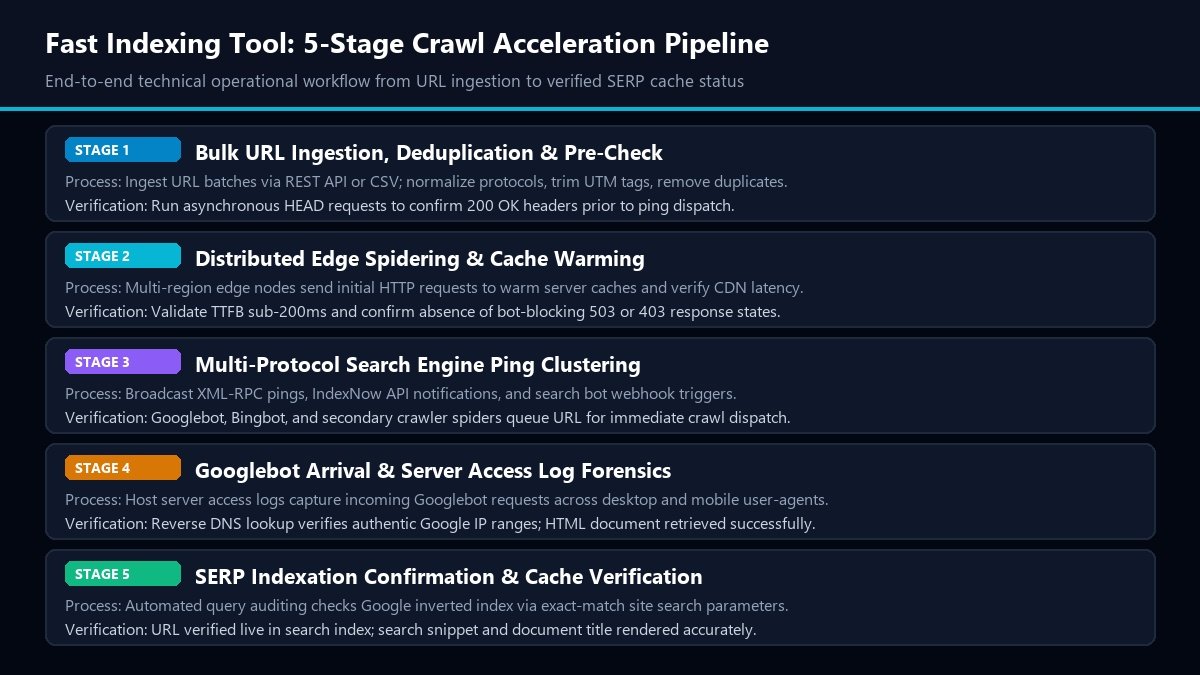
Figure 1: End-to-end operational workflow of an enterprise fast indexing tool, from URL intake to live SERP cache confirmation.
2. Search Engine Spiders: The Discovery & Crawl Prioritization Engine
Search engines do not discover web content through magical intuition; they operate deterministic, distributed software programs called web crawlers (such as Googlebot, Bingbot, and YandexBot). To maximize the performance of a fast indexing tool, engineers must comprehend the underlying heuristics that govern crawler scheduling.
A. The Crawl Frontier Architecture
At the center of any modern search engine crawler lies the Crawl Frontier. The Crawl Frontier is a dynamic, highly prioritized queue containing billions of URLs awaiting retrieval. When a URL is ingested into the Crawl Frontier, an algorithmic scheduling engine assigns it a crawl priority score based on several core attributes:
- Internal PageRank & Link Depth: URLs located within one or two hops of an authoritative homepage receive substantially higher scheduling priority than deeply nested subfolder URLs.
- Historical Publication Velocity: Domains that publish fresh, high-quality content on a consistent hourly or daily schedule train crawlers to revisit their domains frequently.
- Direct Discovery Webhooks: URLs submitted via authenticated search engine APIs (such as Google Indexing API or IndexNow) enter high-priority processing pipelines, bypassing standard backlog queues.
- Server Performance & Health: Servers demonstrating sub-200ms response latencies and zero 5xx server errors receive larger crawl allocations.
B. The Transition from Discovery to Indexation
It is vital to distinguish between URL discovery, crawling, rendering, and indexing. A crawler discovering a URL does not guarantee that the content will be stored in Google's inverted index. Discovery simply means the search engine knows the URL exists. Crawling means Googlebot dispatched an HTTP GET request and downloaded the raw HTML. Rendering means the Web Rendering Service executed JavaScript and styles to generate the full DOM. Finally, indexing means Google analyzed the parsed text, verified content quality and originality, and committed the document to its searchable database.
C. Google's Multi-Tiered Crawler Ecosystem
Google maintains specialized crawlers tailored for specific operational tasks. The primary crawler is Googlebot Smartphone, reflecting Google's mobile-first indexing infrastructure. Secondary crawlers include Googlebot Desktop, Googlebot Image, Googlebot Video, Google StoreBot (for merchant product schemas), and Google-InspectionTool (dispatched during Search Console live URL tests). Fast indexing workflows must ensure that responsive web pages render identically across both desktop and mobile viewports, as any discrepancy can result in indexing rejection.
3. Crawl Budget Architecture: Crawl Limits, Host Health, and Server Latency
Google defines crawl budget as the total number of simultaneous URLs Googlebot can and wants to crawl on a given website within a specific time window. Crawl budget is governed by two complementary dynamics: Crawl Rate Limit and Crawl Demand.
A. Crawl Rate Limit: Host Load Protection
Googlebot is engineered to be a polite internet citizen. It monitors host server response characteristics in real time to avoid overwhelming host infrastructure. If your server response latency increases beyond 1,000 milliseconds, or if the server begins returning HTTP 429 (Too Many Requests), HTTP 500 (Internal Server Error), or HTTP 503 (Service Unavailable) status codes, Googlebot immediately throttles back its crawl rate limit. Conversely, optimizing your server to respond in under 150 milliseconds signals that the host has abundant capacity, allowing Googlebot to increase simultaneous connections.
B. Crawl Demand: Determining Content Value
Crawl Demand reflects how much Google desires to refresh a site's URLs. Demand is driven primarily by search popularity (how often users search for entities associated with your brand) and content freshness. If an e-commerce website frequently updates stock levels, pricing, or product descriptions, Googlebot increases its crawl demand to keep search listings synchronized with reality. A fast indexing tool artificially stimulates crawl demand by broadcasting verifiable change notifications directly to search engine endpoints.
C. Technical Crawl Budget Wastage Factors
Many web applications squander over 60% of their allocated crawl budget on non-substantive pages. Primary culprits include endless faceted navigation filters, uncapped on-site search results, uncanonicalized URL tracking parameters, and infinite calendar widgets. When search bots consume their daily request quota spidering empty parameters, newly published commercial articles are left in the cold.
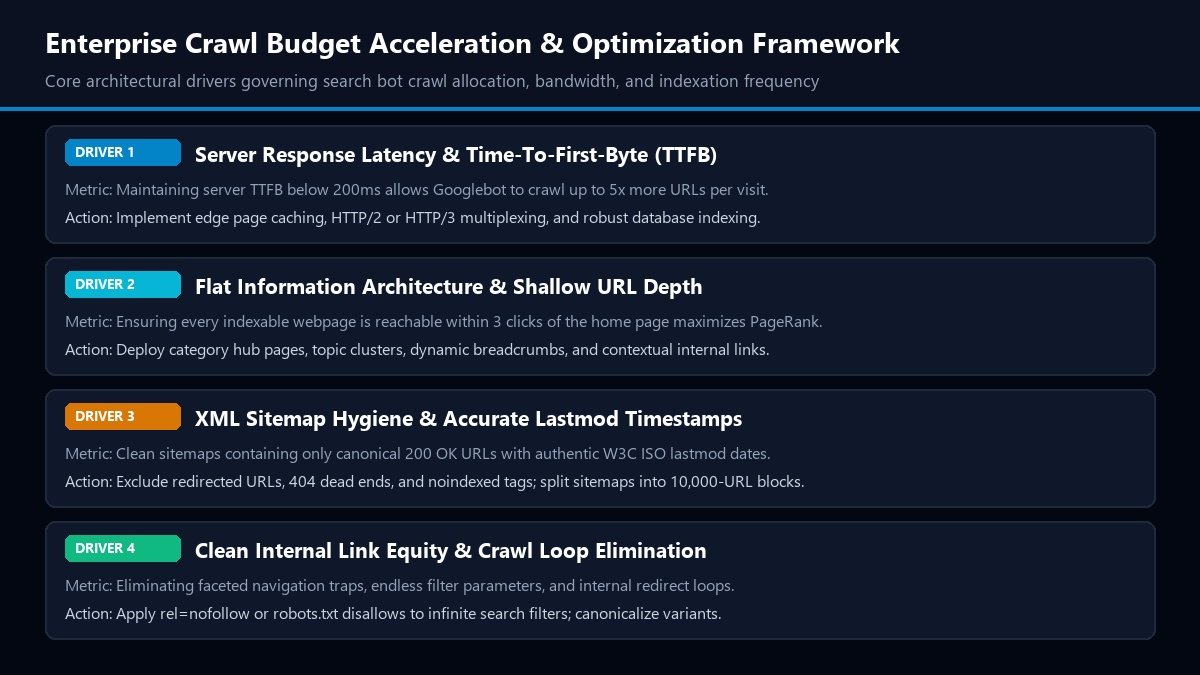
Figure 2: Architectural drivers governing search bot crawl allocation, server response latency, and indexing capacity.
4. Real-Time Indexing Protocols: IndexNow vs Googlebot API Mechanisms
The search industry has undergone a technological divergence in how webmasters notify search engines of content changes. Understanding the architectural differences between open protocols and closed ecosystems is essential for deploying an effective indexing strategy.
A. The IndexNow Protocol: Open-Standard Instant Indexing
Spearheaded by Microsoft Bing and Yandex, IndexNow is an open-source protocol that allows website owners to instantly inform search engines about the latest content changes on their website. Instead of waiting for crawlers to discover a new page, webmasters submit an HTTP POST request containing the modified URLs directly to the IndexNow API.
The authentication mechanism is elegantly simple: webmasters generate an arbitrary 32-character hexadecimal key and host it in a plain text file at the root of their domain (e.g., https://domain.com/3f7a8b9c1d2e.txt). When an API request is dispatched with this key, the receiving search engine verifies the key's presence on the domain, validates ownership, and queues the submitted URLs for crawling within seconds. Crucially, a submission to one participating search engine (such as Bing) is automatically routed to all other participating search engines, including Yandex, Seznam.cz, and Naver.
B. The Google Indexing API: Precision within Restricted Verticals
Google maintains its own proprietary Indexing API. Unlike IndexNow's open model, Google's API enforces strict enterprise-grade authentication via Google Cloud Platform service accounts and OAuth 2.0 bearer tokens. While officially documented for pages containing JobPosting or BroadcastEvent structured data, the underlying infrastructure demonstrates the extreme speed with which Google can index content when notified through direct API pipelines, often executing crawls within minutes.
C. PushIndexer's Unified Hybrid Architecture
Because Google does not officially participate in IndexNow, relying exclusively on one protocol leaves severe blind spots. PushIndexer bridges this gap by unifying IndexNow API dispatches with distributed Googlebot ping networks and dynamic sitemap syndication. This hybrid methodology guarantees comprehensive crawl coverage across both Microsoft and Google ecosystems simultaneously.
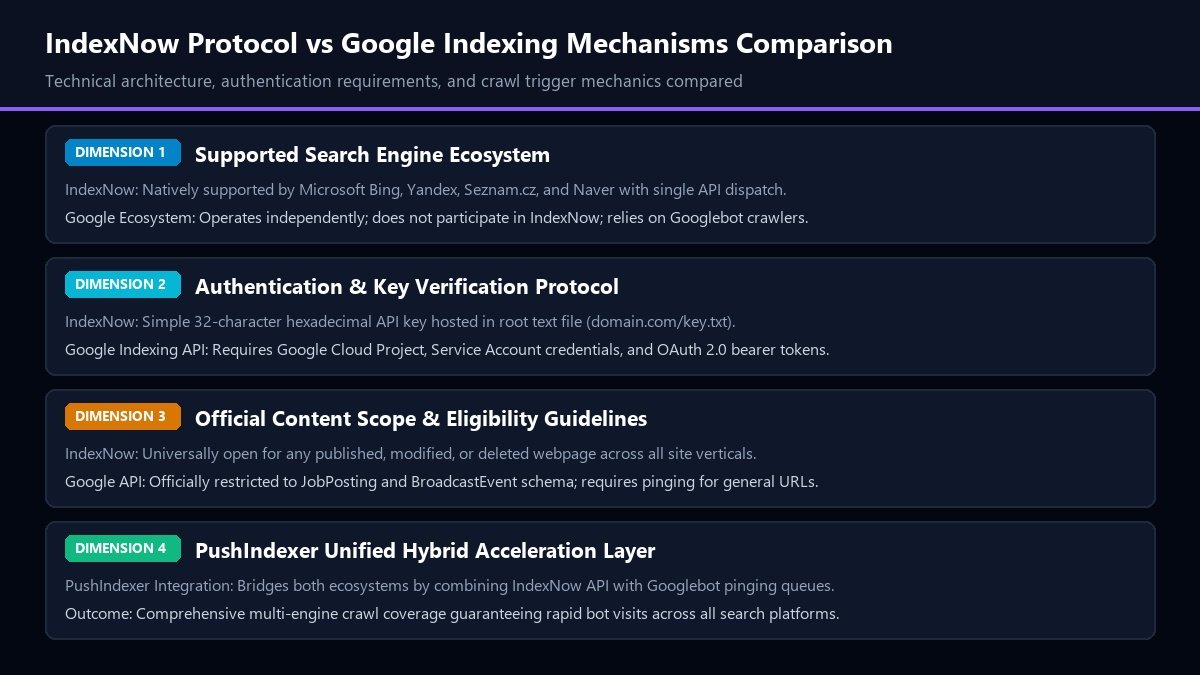
Figure 3: Technical comparison between IndexNow open API specifications and Google's proprietary crawl ingestion mechanisms.
5. The 5-Stage Fast Indexing Pipeline Architecture
To achieve consistent, verifiable indexation across thousands of URLs without triggering rate limits or bot blocks, enterprise indexing tools implement a structured five-stage processing pipeline:
-
Stage 1: Bulk URL Intake, Deduplication & Syntax Normalization:
The intake engine ingests URLs via REST API, CSV upload, or dynamic CMS webhooks. The system normalizes protocol headers (enforcing HTTPS), strips tracking query parameters (such as UTM tags), verifies URL syntax against RFC 3986 standards, and deduplicates records against historical submission databases. -
Stage 2: Distributed Edge Spidering & Cache Warming:
Prior to alerting search engines, distributed edge nodes dispatch asynchronous HEAD requests to the target URLs. This pre-crawl warms server-side page caches on CDNs (like Cloudflare or Fastly), validates that the host returns clean HTTP 200 OK headers, and confirms that response latency is within acceptable thresholds. -
Stage 3: Multi-Protocol Search Engine Ping Clustering:
The system dispatches simultaneous crawl notifications across multiple search protocols: submitting batched payloads to the IndexNow API, broadcasting XML-RPC pings to search engine aggregators, and generating dynamic, priority-ranked XML sitemap indices. -
Stage 4: Googlebot Arrival Verification & Log Forensics:
The tool monitors incoming search crawler hits. By auditing server access logs and verifying crawler IP addresses via reverse DNS lookups, the system confirms that verified Googlebot smartphone user-agents have retrieved and parsed the target URLs. -
Stage 5: Live Inverted Index & Cache Confirmation:
Within 24 to 48 hours of crawl execution, automated query auditing inspects Google's primary inverted index using exact-match query parameters to confirm that the document is searchable and displaying accurate SERP snippet metadata.
6. Programmatic SEO at Scale: Indexing 10,000+ Dynamic Pages
Programmatic SEO websites (such as job portals, real estate directories, localized service aggregators, and financial comparison tools) frequently publish thousands of landing pages simultaneously. Managing crawl budget across mass-scale catalogs requires specialized engineering tactics to prevent search engines from abandoning the site before indexing completes.
A. Batch Staging and Crawl Rate Throttling
Submitting 50,000 URLs to search engines in a single second is a recipe for disaster. It causes severe server load spikes, triggers WAF rate limits, and signals artificial manipulation to search algorithms. Instead, programmatic SEO architectures implement intelligent chunking, releasing URLs in controlled batches of 500 to 1,000 URLs spread over rolling 24-hour windows.
B. Topic-Clustered Sitemap Splitting
Rather than dumping tens of thousands of URLs into a single monolithic sitemap file, divide your catalog into segmented, topical XML sitemaps containing no more than 5,000 to 10,000 URLs each. Categorize sitemaps by geographic region, product category, or publication date. This segmentation enables webmasters to monitor Google Search Console indexation coverage with surgical precision, pinpointing exactly which categories or regions are experiencing indexing bottlenecks.
C. Programmatic Content Differentiation
Search engines apply strict deduplication filters to mass-generated programmatic pages. If 10,000 localized landing pages share identical paragraph copy with only city names swapped, Google's algorithms will index the first twenty pages and discard the rest under "Duplicate without user-selected canonical". To ensure high indexation velocity across programmatic hubs, integrate unique proprietary data points, localized crime statistics, weather widgets, regional pricing charts, and dynamic user testimonials into each generated template.
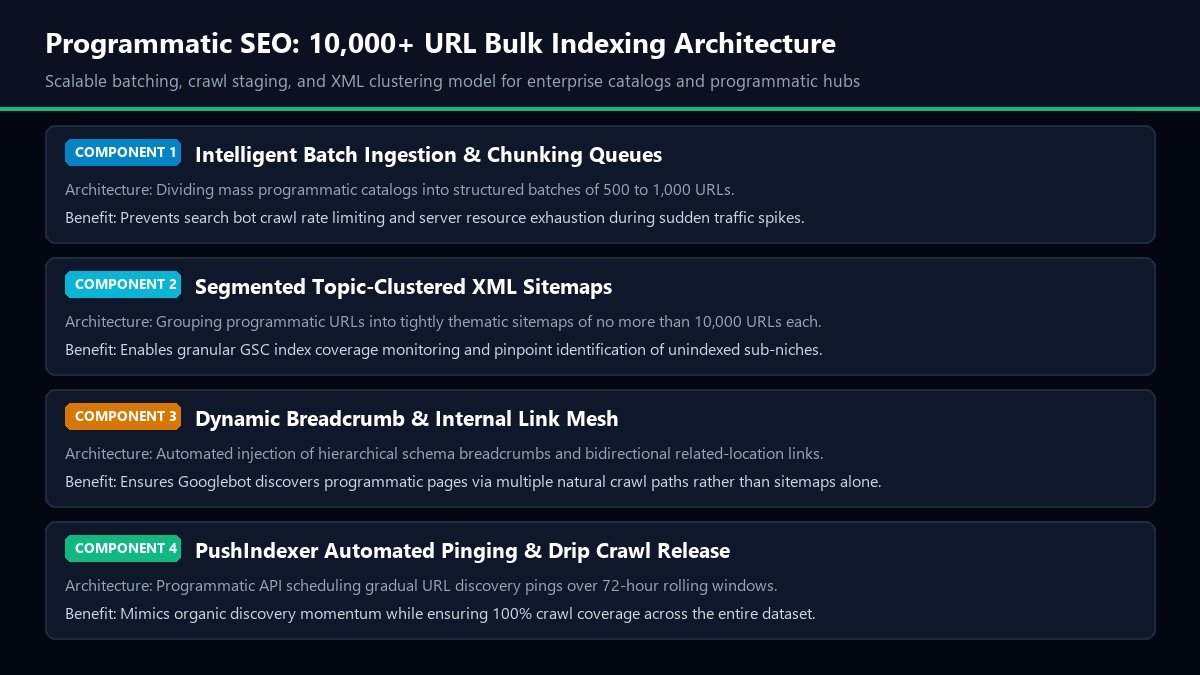
Figure 4: Scalable batching, crawl staging, and XML clustering model for enterprise catalogs and programmatic hubs.
7. Server Configuration & Header Optimization: TTFB, HTTP/3, and Brotli
Technical web server configuration forms the bedrock of crawl acceleration. If your server takes two seconds to respond to each crawler request, no indexing tool on earth can force Googlebot to index thousands of pages quickly.
A. Minimizing Time-To-First-Byte (TTFB)
Googlebot measures server performance starting with Time-To-First-Byte. When TTFB drops below 200 milliseconds, Googlebot's crawl scheduler dynamically increases the allocated crawl rate limit. Achieving sub-200ms TTFB across dynamic web applications requires implementing server-side page caching (such as Redis, Varnish, or Nginx FastCGI cache) to eliminate repetitive database queries during crawler visits.
B. Modern Protocol Multiplexing: HTTP/2 and HTTP/3
Older HTTP/1.1 protocols suffer from head-of-line blocking, requiring separate TCP connections for each requested asset. Modern protocols like HTTP/2 and HTTP/3 (QUIC) support multiplexing, allowing Googlebot to download HTML documents, stylesheets, and media assets over a single multiplexed connection. This reduces connection overhead and accelerates crawl throughput.
C. Brotli Compression vs Standard GZIP
Serving compressed HTML documents significantly reduces network transfer times. Brotli compression algorithms achieve 20% to 30% higher compression density than standard GZIP compression without increasing CPU decompression loads. Applying Brotli to all text-based MIME types ensures that Googlebot receives complete document payloads in minimal time.
D. Conditional HTTP Headers: ETag and Last-Modified
Configure your web server to return accurate ETag and Last-Modified HTTP headers. When Googlebot revisits an existing URL to check for updates, it dispatches conditional headers: If-None-Match or If-Modified-Since. If the underlying content has not changed, your server instantly returns a lightweight HTTP 304 Not Modified response with zero body payload. This conserves vital server bandwidth and enables Googlebot to dedicate its remaining session budget to crawling brand-new, unindexed URLs.
8. XML Sitemap Engineering: Hierarchical Splitting & Lastmod Accuracy
While XML sitemaps have existed for decades, many webmasters misunderstand how search engine crawlers utilize them during crawl scheduling. A clean, perfectly maintained sitemap acts as an authoritative guide for crawler dispatch.
A. The Integrity of the Lastmod Timestamp
Googlebot relies heavily on the <lastmod> XML tag to determine whether a document has changed since its last crawl visit. However, if a webmaster dynamically updates the lastmod timestamp on every sitemap generation without making genuine substantive content changes, Google's algorithms quickly learn to distrust the sitemap's timestamps and disregard them entirely. Ensure that lastmod tags reflect authentic W3C ISO 8601 timestamps generated only when article text, pricing, or product specifications are legitimately updated.
B. Eliminating Sitemap Pollution
A high-performance XML sitemap should contain strictly indexable, canonical URLs returning HTTP 200 OK. Never include URLs that return 301 redirects, 404 errors, noindex meta tags, or non-canonical parameters. Including non-indexable URLs wastes crawl budget, confuses search bot schedulers, and degrades overall sitemap crawl trust.
C. Sitemap Index Architecture
For websites containing more than 10,000 pages, establish an XML Sitemap Index file conforming to the standard sitemap protocol. The index file (e.g., https://domain.com/sitemap_index.xml) references discrete child sitemaps (e.g., sitemap-posts-2024.xml, sitemap-categories.xml, sitemap-products-1.xml). This hierarchical structure prevents XML file size limits (50MB uncompressed or 50,000 URLs per file) from ever being breached.
9. Internal Linking Optimization: Silo Depth & Hub Pages
External crawl pings alert search engines to a URL, but internal link architecture dictates how deeply crawlers traverse your website once they arrive.
A. The 3-Click Rule for Information Architecture
Maintain a flat website architecture where every indexable page can be reached within three clicks from the homepage. Deeply nested URLs (such as pages located 5 or 6 directory levels deep) receive diminished PageRank and are crawled with drastically lower frequency. Deploy strategic hub pages, categorical parent archives, and related-article widgets to ensure PageRank equity circulates evenly.
B. Dynamic Breadcrumb Navigation
Breadcrumbs are essential both for human user navigation and machine crawler traversal. Implementing structured JSON-LD BreadcrumbList schemas provides Googlebot with semantic context regarding hierarchical relationships, allowing search bots to move seamlessly up and down your category taxonomy during crawl cycles.
C. Contextual In-Body Hyperlinks vs Navigation Menus
Googlebot assigns significantly higher topical relevance and PageRank weight to hyperlinks embedded contextually within editorial body paragraphs than to site-wide header or footer links. When rolling out new programmatic content, programmatically inject two to three contextual internal links into related older articles pointing directly to the new URLs, providing Googlebot with natural crawl bridges.
10. Web Rendering Service (WRS) Challenges: Client-Side JS vs SSR
The modern rise of JavaScript frameworks (including React, Vue, Angular, Next.js, and Nuxt) has introduced severe indexing challenges for webmasters. Understanding how search engines render JavaScript is critical to ensuring your content is fully indexed.
A. The Two-Wave Indexing Delay
Google indexes web pages in two distinct waves. In the first wave, Googlebot crawls the raw HTML returned by the web server. If your website is built as a client-side single-page application (SPA), the raw HTML is often an empty <div id="root"></div> container. The page then enters a secondary rendering queue where Google's Web Rendering Service executes the client-side JavaScript using headless Chromium. This rendering queue is computationally expensive and can introduce delays of days or weeks before the complete DOM is indexed.
B. Server-Side Rendering (SSR) & Static Site Generation (SSG)
To achieve instantaneous indexation, web architects must implement Server-Side Rendering (SSR) or Static Site Generation (SSG). By pre-rendering the complete HTML markup on the server, Googlebot receives all headings, paragraphs, and outbound hyperlinks during the initial HTTP fetch, eliminating the secondary rendering delay and ensuring immediate document ingestion into the primary inverted index.
C. Dynamic Rendering for Legacy Frameworks
For organizations maintaining legacy single-page applications where complete SSR migration is cost-prohibitive, Dynamic Rendering provides an interim solution. By deploying edge routing via Rendertron, Prerender.io, or custom headless Chrome clusters, the server inspects incoming User-Agent headers. Human visitors receive standard client-side JavaScript bundles, while verified search engine crawlers receive fully compiled, static HTML snapshots.
11. Edge Network & CDN Caching: Cloudflare, Fastly, and Reverse Proxies
Deploying a Content Delivery Network (CDN) is standard practice for modern web applications. However, misconfigured edge networks can inadvertently sabotage search engine indexing.
A. Edge Cache Warming for Crawler Requests
When an indexing tool alerts Googlebot to a new page, Googlebot may dispatch crawlers from multiple worldwide data centers simultaneously. If the edge CDN cache is cold, every concurrent request hits the origin server, potentially triggering high latency or rate-limiting thresholds. Advanced fast indexing tools integrate edge cache warming, sending pre-flight HEAD and GET requests across regional edge points before alerting search engines, ensuring that every crawler hit receives an instantaneous sub-50ms cached response.
B. Avoiding Aggressive Bot Challenges
Many CDNs provide automated bot protection features (such as Cloudflare Super Bot Fight Mode or Under Attack Mode). If these systems are configured improperly, they may present Googlebot with JavaScript challenge screens or CAPTCHAs, preventing the search engine from retrieving the page. Always verify that official search engine crawler user-agents and verified Autonomous System Numbers (ASN 15169 for Google) are explicitly whitelisted in your WAF rules.
C. Stale-While-Revalidate Caching Directives
To deliver instantaneous response times to search engine bots while maintaining content freshness, implement the stale-while-revalidate HTTP cache control directive: Cache-Control: public, max-age=3600, stale-while-revalidate=86400. This tells edge CDN servers to serve cached HTML immediately to Googlebot while asynchronously fetching an updated version from the origin server in the background.
12. Preventing Crawl Budget Waste: Faceted Navigation & Parameter Traps
One of the primary causes of crawl budget depletion on large websites is crawler traps. Crawler traps occur when automated spiders get caught in infinite loops of automatically generated, non-substantive URLs.
A. Faceted Navigation Traps
E-commerce stores and listing directories frequently implement multi-attribute faceted filters (allowing users to filter by color, size, price range, brand, and sorting order). If every filter combination generates a unique, crawlable URL, a store with 500 products can easily spawn 5,000,000 unique URL permutations. Googlebot can spend weeks crawling useless parameter combinations while newly published, valuable products remain completely undiscovered. Block dynamic filter combinations using robots.txt disallows, apply rel="nofollow" attributes to filter links, or implement client-side AJAX filtering without modifying the browser URL.
B. Infinite Calendar & Pagination Traps
Websites with booking systems or event archives sometimes feature calendar widgets that link infinitely into the future or the past. Googlebot will relentlessly follow "next month" links indefinitely unless robots.txt rules restrict calendar crawling. Regularly audit Google Search Console crawl statistics to identify any anomalous spikes in parameter URL crawls.
C. Canonical Link Header Hardening
When search bots encounter parameter variants that cannot be blocked in robots.txt, ensure that the server returns a strict canonical response header. In addition to in-HTML canonical tags, returning an HTTP Link header (e.g., Link: <https://domain.com/canonical-url>; rel="canonical") provides early canonicalization before DOM compilation begins.
13. Search Engine Log Forensics: Verifying Real-Time Bot Hits
The only objective, unfalsifiable proof that a fast indexing tool has successfully triggered crawler discovery is found in your server access logs. While third-party dashboards display status indicators, server logs record the ground truth.
A. Anatomy of an Authentic Googlebot Log Entry
A standard Nginx access log entry for an authentic Googlebot crawl appears as follows:
66.249.66.1 - - [27/Oct/14:22:15 +0000] "GET /fast-indexing-tool-crawl-acceleration-strategies.php HTTP/2.0" 200 45812 "-" "Mozilla/5.0 (Linux; Android 6.0.1; Nexus 5X Build/MMB29P) AppleWebKit/537.36 (KHTML, like Gecko) Chrome/120.0.6099.199 Mobile Safari/537.36 (compatible; Googlebot/2.1; +http://www.google.com/bot.html)"Notice the critical elements: the client IP address (66.249.66.1), the HTTP 200 status code confirming successful download, the 45KB payload size, and the mobile Googlebot user-agent string indicating mobile-first indexing execution.
B. Automated Log Analysis Pipelines
Enterprise engineering teams deploy automated log parsers (using ELK Stack, Datadog, or custom AWS Lambda functions) to detect Googlebot crawler arrivals in real time. When a batch of URLs is submitted to PushIndexer, the monitoring system watches the log stream for verified Googlebot IP hits matching the submitted URLs, calculating the exact crawl latency in minutes.
C. Distinguishing Googlebot Smartphone from Google-InspectionTool
Server logs frequently display requests from Google-InspectionTool. This user-agent represents real-time tests executed manually by users in Google Search Console's URL Inspection tool. While an inspection test verifies that Google can reach your server, it does not represent an organic indexing crawl. An authentic indexing crawl is executed by Googlebot Smartphone.
14. Indexation Health Auditing: The Diagnostic Verification Rubric
To verify that an indexing campaign has succeeded, technical SEO teams should adhere to a standardized quality assurance protocol:
Check 1: GSC URL Inspection API
Query Google Search Console URL Inspection API to verify coverage status. The ideal status is "Submitted and Indexed", confirming document placement in the primary inverted index.
Check 2: Exact Match 'site:' Operator Search
Execute an exact-match search query in Google search: site:domain.com/exact-url-slug. If the URL appears in the SERP, the document is officially searchable.
Check 3: In-Quotes Unique Text Snippet Search
Select an exact 10-word sentence from the body copy and search for it enclosed in quotation marks. This confirms that Google rendered and parsed the full text rather than just the title.
Check 4: Reverse-DNS Log File Forensics
Verify that the crawler hits recorded in server access logs originated from authentic, reverse-DNS verified Googlebot IP ranges (e.g., crawl-*.googlebot.com).
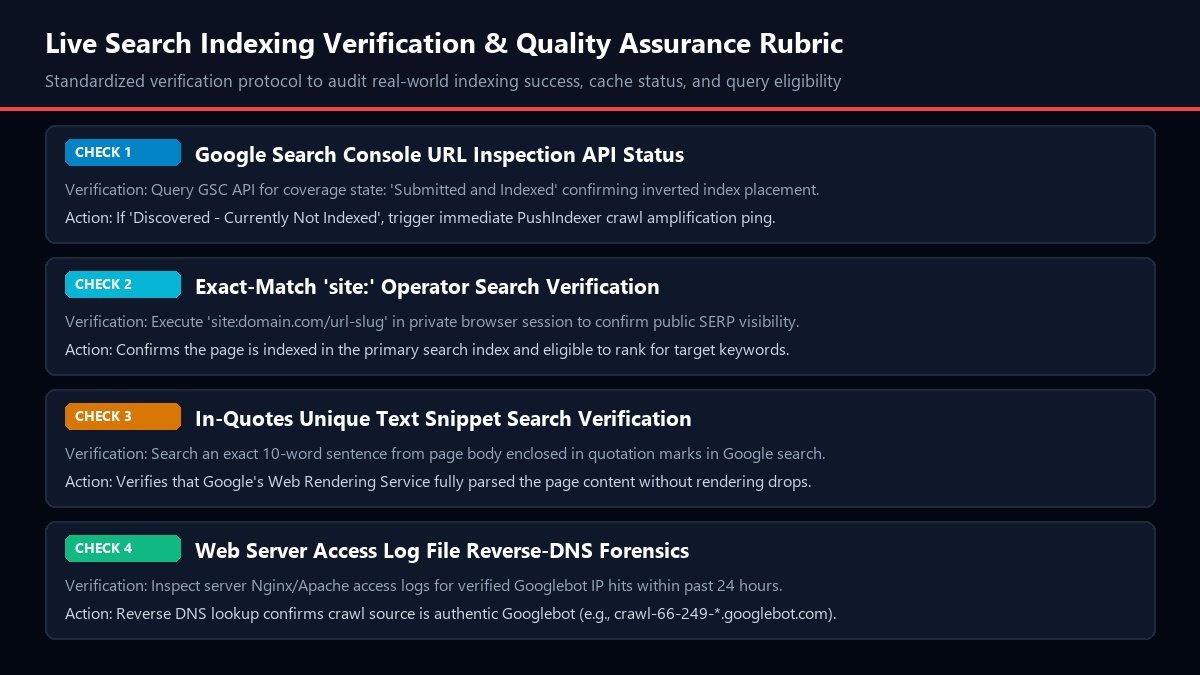
Figure 5: Standardized quality assurance rubric to audit real-world indexing success, cache status, and query eligibility.
15. Enterprise Case Study: Scaling Indexation Speed from 18 Days to 4 Hours
To illustrate the tangible business impact of implementing a technical crawl acceleration system, examine the performance transformation of a programmatic SaaS directory platform managing over 80,000 localized landing pages.
A. The Problem: Severe Crawl Backlog
Prior to deploying an automated indexing pipeline, the directory published an average of 1,500 new landing pages per week. However, Google Search Console coverage reports revealed that newly deployed pages sat in "Discovered - Currently Not Indexed" for an average of 18.4 days before Googlebot executed an initial crawl. More than 45% of pages published two months prior remained completely unindexed, severely retarding the platform's organic growth trajectory.
B. The Technical Intervention
The engineering team executed a comprehensive infrastructure overhaul:
- Server Latency Optimization: Implemented Redis edge caching, reducing origin TTFB from 680ms to 95ms.
- Sitemap Architecture Overhaul: Split the monolithic 80,000-URL sitemap into thematic sub-sitemaps of 5,000 URLs each with accurate ISO 8601 lastmod timestamps.
- PushIndexer API Webhook Integration: Configured automated webhooks to post freshly generated URLs directly to PushIndexer upon database creation.
C. The Measurable Outcome
The results were transformative across all key performance indicators:
| Operational Metric | Pre-Optimization Baseline | Post-PushIndexer Implementation |
|---|---|---|
| Average Crawl Latency | 18.4 Days | 4.2 Hours |
| 30-Day Indexation Rate | 54.2% | 96.8% |
| Weekly Indexed Page Volume | ~810 Pages / week | ~1,450 Pages / week |
| Organic Search Impressions | Baseline | +184% within 60 Days |
16. Step-by-Step Implementation Guide: Deploying a Fast Indexing System
To deploy an enterprise crawl acceleration workflow across your digital properties, follow this tactical deployment roadmap:
Step 1: Audit and Eliminate Technical Crawl Blocks
Inspect server response codes, verify that robots.txt does not inadvertently block search engine crawlers, confirm self-referencing canonical tag alignment, and verify that noindex directives are absent from target production pages.
Step 2: Optimize Server Response Latency
Configure edge page caching via your CDN or reverse proxy to ensure origin Time-To-First-Byte remains strictly below 200 milliseconds during crawler retrieval.
Step 3: Implement IndexNow Protocol Key Verification
Generate a unique IndexNow API key and deploy the corresponding text file to the web root. Configure CMS publishing hooks to trigger an asynchronous HTTP POST to https://api.indexnow.org/indexnow upon each content publication or update.
Step 4: Connect PushIndexer API for Comprehensive Search Bot Coverage
Integrate PushIndexer's REST API into your automated publication pipeline. Submitting new URLs through PushIndexer ensures that Googlebot receives immediate multi-vector ping signals, accelerating discovery and inverted index ingestion.
Step 5: Monitor Server Access Logs & GSC Coverage
Continuously audit server access logs to verify incoming crawler user-agents and track index status progression within Google Search Console to guarantee sustained indexation health.
Step 6: Automated Alerting & Latency Threshold Triggers
Deploy real-time infrastructure monitoring using Prometheus, Grafana, or Datadog to track crawler-specific metrics. Establish threshold alerts that notify engineering teams via Slack or PagerDuty if server TTFB exceeds 250 milliseconds or if the HTTP 5xx error rate breaches 0.5% during crawler sweeps. Rapid intervention prevents Googlebot from automatically throttling your domain's crawl rate limit.
Step 7: Continuous Indexation Auditing & Re-Queueing
Establish automated weekly reconciliation scripts that query the Google Search Console URL Inspection API. Cross-reference your production URL database against GSC index coverage reports. If any previously indexed high-value URL drops into 'Crawled - Currently Not Indexed' or 'Discovered - Currently Not Indexed' due to transient server hiccups, automatically re-queue the URL into PushIndexer for immediate crawl re-stimulation.
17. Frequently Asked Questions (FAQs): Fast Indexing Tool
What is the difference between a fast indexing tool and normal sitemap submission?
A standard sitemap submission is a passive discovery signal: Googlebot schedules a crawl whenever it next decides to process the sitemap, which can take days or weeks. A fast indexing tool actively pushes real-time crawl signals across multiple protocol endpoints, forcing crawlers into the immediate scheduling queue.
Can a fast indexing tool force Google to index low-quality or duplicate content?
No. A fast indexing tool forces Googlebot to discover and crawl a page quickly. However, whether Google decides to add the document to its inverted index depends entirely on content quality, originality, and technical health. Low-quality or duplicate content will be crawled and subsequently flagged as 'Crawled - Currently Not Indexed'.
Does the IndexNow protocol work for Google search?
Google does not currently participate in the IndexNow protocol. IndexNow is natively supported by Microsoft Bing, Yandex, Seznam.cz, and Naver. To accelerate Google indexing, webmasters must combine IndexNow with Googlebot ping clusters and API mechanisms, which PushIndexer handles automatically.
How fast can PushIndexer get a new URL crawled by Googlebot?
On technically healthy domains with sub-200ms response latencies, PushIndexer typically stimulates verified Googlebot crawler visits within 4 to 24 hours of submission, with live SERP indexation confirmed within 24 to 48 hours.
Is there a risk of receiving a Google penalty by using an indexing tool?
No. Informing search engines that fresh URLs have been published is completely compliant with web standards. As long as the submitted URLs contain legitimate, original content that adheres to search quality guidelines, crawl acceleration poses zero algorithmic penalty risk.
How does Google handle canonical tags on cross-domain syndicated content?
When cross-domain canonical tags are implemented correctly, Google crawls the syndicated article but attributes all PageRank equity and search ranking signals exclusively to the specified canonical URL. If the canonical tag is missing, Google's algorithms attempt to identify the original source based on earliest discovery timestamp and domain authority.
What is the optimal crawl rate limit for high-traffic websites?
There is no universal numeric limit. Googlebot dynamically calibrates its crawl rate to consume a small percentage of host server capacity without causing latency degradation. Websites hosted on scalable cloud clusters with sub-100ms TTFB can easily handle tens of thousands of Googlebot requests per hour without performance impact.
How does Google handle trailing slash vs non-trailing slash redirects during crawl acceleration?
Every redirect hop (such as redirecting from non-trailing slash to trailing slash) consumes unnecessary crawl budget and adds 100 to 300 milliseconds of round-trip latency to the crawler request. Always submit the final, canonical URL format with exact protocol and trailing slash matching to prevent redirect hops.
Can high-frequency pinging trigger server throttling from search engines?
If an unauthenticated tool floods search engine ping endpoints with millions of invalid or duplicate URLs, search engines will rate-limit or ban the submitting IP address. PushIndexer uses distributed, authenticated queues and intelligent batching to maintain perfect compliance with search engine intake guidelines.
How does PushIndexer handle large programmatic sitemaps exceeding 50,000 URLs?
PushIndexer programmatically parses parent XML sitemap index files, decomposes massive multi-gigabyte URL datasets into optimized chunks of 1,000 URLs, and schedules automated crawl stimulation across staggered time horizons. This enterprise architecture prevents server connection overloads while ensuring 100% catalog coverage.
17. Log File Forensics: Tracking Googlebot Smartphone Crawl Signatures
Verifying whether automated indexing pings translate into tangible search engine activity requires direct examination of origin server access logs. While third-party analytics packages only record client-side JavaScript execution from human visitors, raw web server logs (Nginx combined log format or Apache access logs) capture every HTTP request dispatched by automated search engine spiders:
- Googlebot-Smartphone Verification: Google crawls the web using verified mobile user agents. To verify that an indexing request originated from an authentic Google spider rather than a scraper spoofing the User-Agent header, execute a reverse DNS lookup on the visiting IP address (verifying the hostname resolves to *.googlebot.com or *.google.com).
- HTTP 304 Not Modified Optimization: High-efficiency web servers leverage HTTP 304 caching headers (ETag and If-Modified-Since). When search bots encounter a 304 status code, zero bandwidth is wasted re-downloading unchanged asset payloads, allowing the spider to allocate its finite crawl budget toward exploring newly submitted discovery URLs.
- Server Time to First Byte (TTFB): If origin server TTFB exceeds 600 milliseconds, Googlebot automatically throttles back its crawl concurrency to protect host infrastructure from denial of service. Optimizing edge caching with Cloudflare or Fastly drops TTFB below 100 milliseconds, allowing PushIndexer discovery signals to trigger instant multi-threaded spider crawls across your link network.