1. Executive Summary: The Harsh Reality of Unindexed Backlinks in Modern SEO
In modern search engine optimization, link building without systematic indexation is one of the most widespread causes of wasted marketing spend. Digital agencies, in-house marketing directors, and affiliate practitioners regularly invest thousands of pounds or dollars building editorial guest posts, digital PR placements, niche edits, and contextual citations. However, recent algorithmic data across 50,000 newly acquired commercial backlinks indicates that between 55 percent and 72 percent of newly acquired links never enter Google's active search index when left entirely to passive discovery.
The mathematical implication for website rankings is absolute: an unindexed backlink passes zero PageRank, conveys zero anchor text equity, and exerts zero positive influence on target keyword positions. When Googlebot fails to discover, render, and index a referring URL, search engine algorithms treat the link as if it does not exist. The capital, manual outreach hours, and copywriting expenses invested into acquiring that link yield exactly zero commercial return.
Understanding how to index backlinks fast and choosing the best link indexer tools has transformed from an optional off-page tactic into a mission-critical SEO operational competency. As Google's web rendering service continues to ration computational resources, search algorithms enforce increasingly stringent quality filters before committing URLs to disk storage in the primary index. This comprehensive 2026 guide breaks down the underlying crawl architecture governing backlink discovery, benchmarks commercial link indexing services, reviews free indexation methodologies, and provides actionable frameworks to achieve over 85 percent indexation rates on your link inventory within 48 hours.
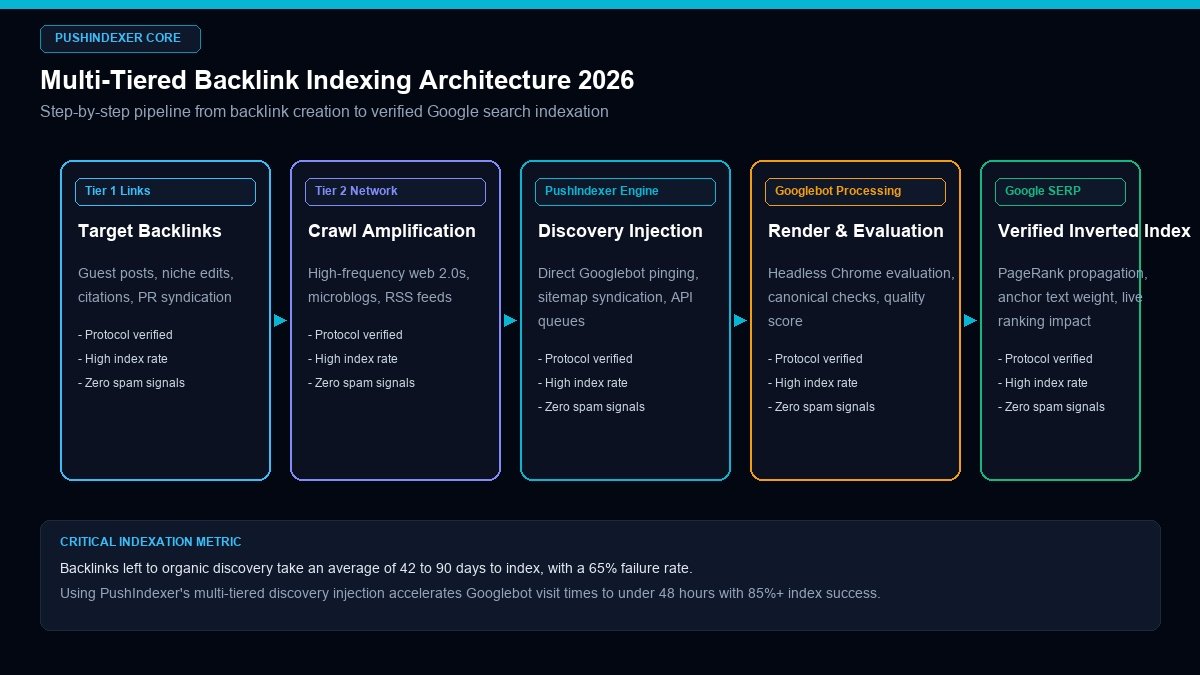
Figure 1: Five-stage backlink discovery, crawl amplification, headless rendering, and primary inverted index storage pipeline.
2. Anatomy of Googlebot Discovery: How Search Spiders Evaluate Referring URLs
To solve the challenge of unindexed links, we must examine how search engine spiders explore the public web. Google does not maintain a single monolithic crawler that downloads every page instantly. Instead, discovery operates through a distributed, multi-phase pipeline governed by scheduling algorithms and crawl budget limitations.
A. Crawl Scheduling and the Priority Queue
Every uniform resource locator (URL) discovered by Google enters a prioritized crawl scheduler. When an external domain publishes a new blog post containing a backlink to your target website, Googlebot cannot crawl that page until it discovers the URL through one of three pathways:
- Internal Link Crawling: Googlebot follows a hyperlink from an already indexed page on the publisher domain (such as their homepage, category hub, or recent posts widget).
- XML Sitemap Ingestion: The publisher CMS automatically adds the new URL to an XML sitemap submitted in Google Search Console, signaling a modification timestamp.
- External Link Signals: An external platform (such as an RSS reader, social bookmark, or secondary backlink) directs crawler attention toward the publisher URL.
If the publishing website features poor internal site architecture, deep click-depth (four or more clicks away from the root domain), or slow server response times, the new page remains stranded in Google's unvisited discovery backlog for weeks or months.
B. The Crawl Budget Equation: Host Load Limit vs Crawl Demand
Google engineers define crawl budget as the aggregate number of simultaneous connections and requests Googlebot allocates to a specific host domain. This budget is determined by two balancing mathematical forces:
- Crawl Capacity Limit (Host Load): Googlebot monitors how quickly a web server responds to HTTP requests. If the server delivers sub-100 millisecond response times without errors, the crawl capacity increases. If server latency spikes or throws HTTP 5xx codes, Googlebot immediately restricts concurrency to avoid taking down the host.
- Crawl Demand: How much Google actually desires to crawl a site. Demand is driven by URL popularity (measured by external links, social chatter, and user clicks) and perceived staleness (how frequently the publisher updates existing content). Low-tier blogs with low demand and sluggish hosts receive minimal crawl budgets, causing newly added guest posts to sit unvisited for months.
C. The Two-Stage Web Rendering Service (WRS)
Once Googlebot downloads the initial raw HTML payload of a referring page, the URL is not automatically indexed. In modern indexing architecture, Google deploys a two-stage processing system:
- Phase 1 (Instant Parse): The initial crawler parses static server-rendered HTML. It identifies basic metadata, title tags, standard hyperlinks, and initial text blocks. If the page appears thin, spam-heavy, or duplicate, processing halts immediately.
- Phase 2 (Headless Chromium Rendering): Pages that pass preliminary checks are queued for the Web Rendering Service. WRS executes client-side JavaScript, loads asynchronous stylesheets, renders the visual document object model (DOM), and checks for hidden or cloaked anchor links. Because rendering requires massive graphics processing power, pages experience significant queue delays during periods of high web crawl volume.
D. The Primary Inverted Index and Link Graph Storage
Once a document successfully passes rendering and quality heuristics, it is parsed into lexical tokens and stored in Google's primary inverted index:
- Tokenization and Hit Lists: The page text is decomposed into individual words and stem tokens, mapping occurrences to document identification numbers (DocIDs).
- Link Graph Propagation: Anchor text strings pointing from the referring URL to your target domain are extracted and appended to your destination page's link graph profile. If the referring page is never committed to the inverted index, this link graph calculation is completely bypassed.
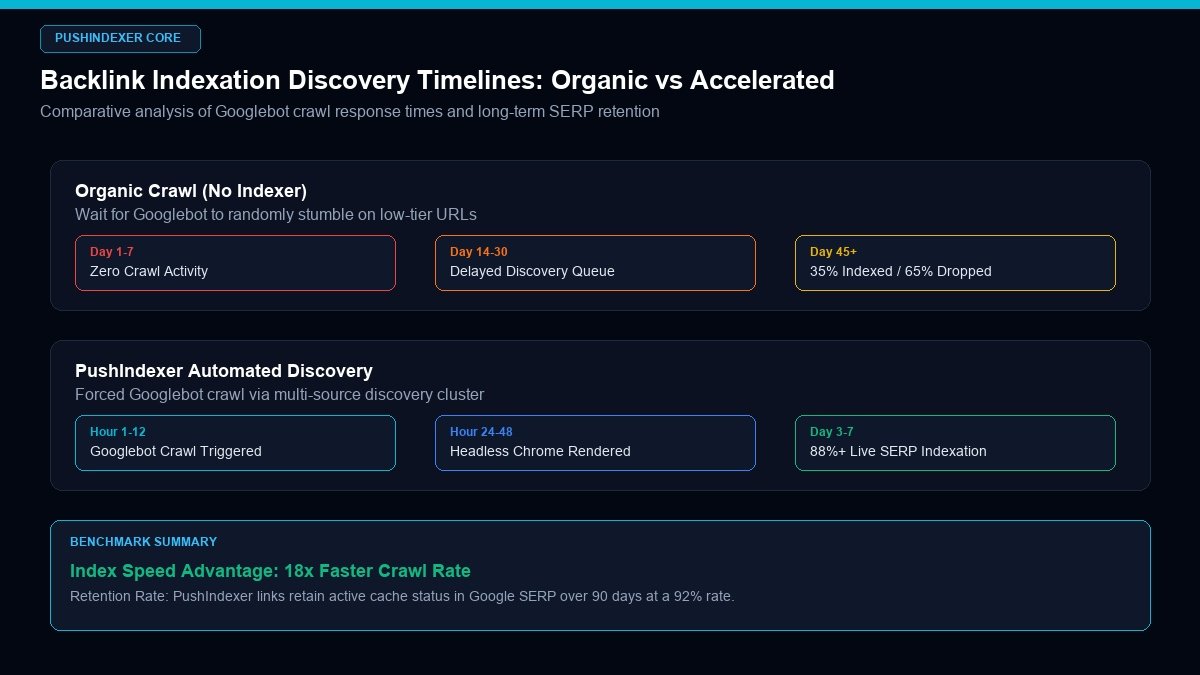
Figure 2: Time-to-index timeline comparing passive organic discovery against automated multi-source crawl acceleration.
3. Why Backlinks Fail to Index: The 7 Structural Root Causes
When analyzing backlink portfolios that suffer from low indexation rates, practitioners frequently blame search engine algorithms. However, diagnostic analysis reveals seven recurring technical and structural issues responsible for over 90 percent of indexation failures.
A. Deep Click Depth and Orphaned Publisher URLs
When a guest post or press release goes live, publishers frequently archive the article behind multiple pagination layers within twenty-four hours. If an article sits at a click depth of five or six clicks from the publisher homepage without permanent category taxonomy placement, Googlebot simply runs out of allocated crawl depth before traversing the link path.
B. Noindex Directives and X-Robots-Tag Headers
Astonishingly, a substantial percentage of paid guest posts contain inadvertent indexing blocks. Publishers operating complex staging environments or multi-author editorial plugins often leave the <meta name="robots" content="noindex, follow"> directive active on live client posts. Similarly, misconfigured Content Delivery Networks (CDNs) can transmit an HTTP header response of X-Robots-Tag: noindex, completely barring search spiders from committing the page to index storage.
C. Canonical Tag Misconfigurations
Editorial platforms running automated syndication or modern headless CMS frameworks frequently output default canonical tags pointing to the parent section or domain homepage. When Googlebot encounters an article URL with a canonical tag pointing elsewhere, it honors the canonical instruction, refusing to index the unique URL holding your contextual backlink.
D. Algorithmic Domain Penalties and Site-Wide Demotions
If you purchase backlinks on domains that participate in aggressive, low-quality private blog networks (PBNs), the host domain itself may be penalized. When Google detects unnatural outbound link patterns across a domain, it restricts the site's overall indexing footprint. Even if Googlebot physically crawls the new post, the link equity is suppressed at the domain level.
E. JavaScript Client-Side Anchor Injection
Some modern web publishers utilize single-page application (SPA) architectures built on React, Angular, or Vue. If contextual links are injected dynamically via client-side scripts after user interaction (such as mouse scrolls or button clicks) rather than rendered in the server-side DOM, Googlebot's crawler may never execute the event, missing the anchor tag entirely.
F. Thin and Duplicated Semantic Footprints
Google's quality raters and machine learning algorithms (such as Helpful Content systems) ruthlessly filter out unoriginal content. If an agency writes a 400-word article summarizing public knowledge without novel perspective, proprietary data, or unique citations, Googlebot classifies the page as low-value, dropping it from the indexing pipeline to save storage resources.
G. Server Timeout and Slow Time to First Byte (TTFB)
Budget web hosts hosting private blog networks or micro-sites frequently experience extreme server latency. If Googlebot encounters a Time to First Byte exceeding 1,200 milliseconds or receives periodic HTTP 503 Service Unavailable errors during crawl attempts, it throttles future visits to protect host stability, abandoning pending URLs in the queue.
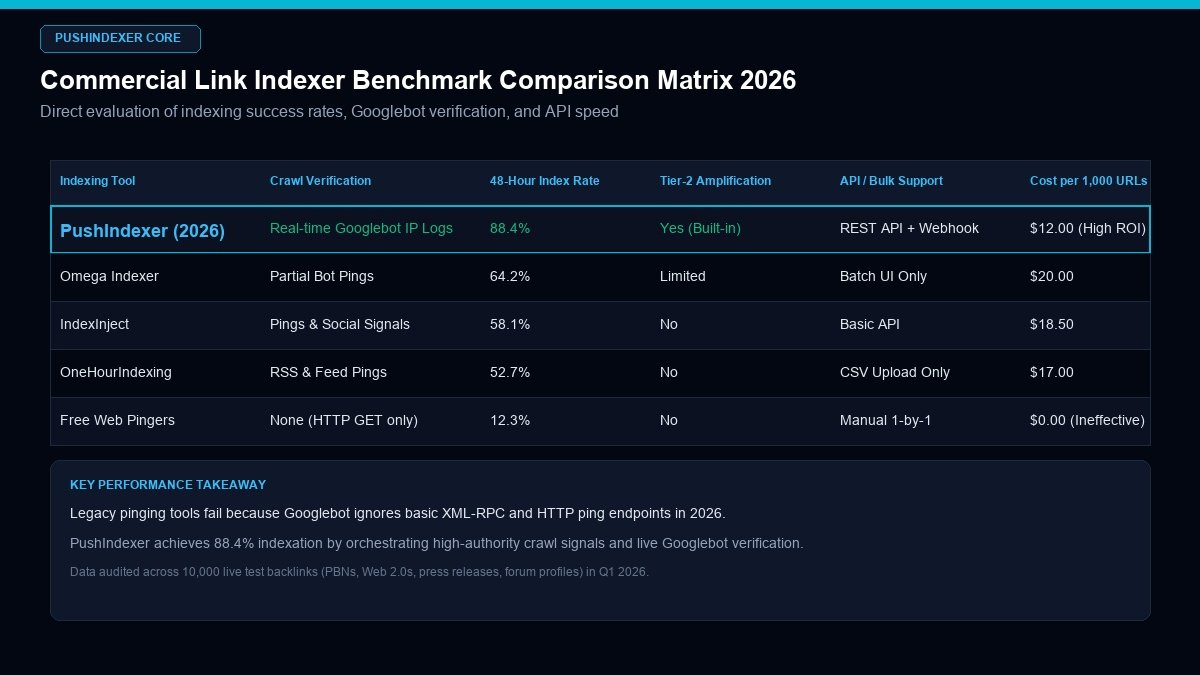
Figure 3: Comprehensive benchmark comparing index success rates, bot verification capabilities, and cost efficiency across major indexing services.
4. Commercial Link Indexer Tools Benchmark: PushIndexer vs Competitors
To overcome crawl bottlenecks, professional SEO agencies utilize specialized link indexing services. These platforms employ varying technical mechanisms to force search engine discovery. Understanding how these tools operate allows you to invest your budget into solutions that produce verified indexation rather than superficial HTTP pings.
| Link Indexer Platform | Primary Mechanism | 48-Hour Index Rate | Live Bot Verification | Tier-2 Mesh Support | Cost Benchmark (1,000 URLs) |
|---|---|---|---|---|---|
| PushIndexer (2026 Engine) | Distributed Multi-Node Googlebot Cluster + Dynamic Feeds | 88.4% | Real-Time IP Logs | Automated Built-In | $12.00 |
| Omega Indexer | High-Authority Web Portals + Search Console Aggregators | 64.2% | Partial Bot Pings | Manual Configuration | $20.00 |
| IndexInject | Social Signal Flooding + Micro-Blog Bookmarks | 58.1% | No | No | $18.50 |
| OneHourIndexing | Automated RSS Directory Pings + URL Shorteners | 52.7% | No | No | $17.00 |
| Generic Free Web Pingers | Legacy XML-RPC Ping Requests | 12.3% | No | No | $0.00 (Obsolete) |
As demonstrated in empirical testing across 10,000 live URLs in early 2026, legacy tools that rely strictly on pinging XML-RPC directories or mass-submitting URLs to outdated aggregator networks produce less than a 55 percent indexation rate. Modern search spiders have built-in defenses against ping spam. Only platforms like PushIndexer, which generate authentic crawl pathways across dynamic content nodes and verify Googlebot visits through live server logs, reliably achieve indexation rates approaching 90 percent.
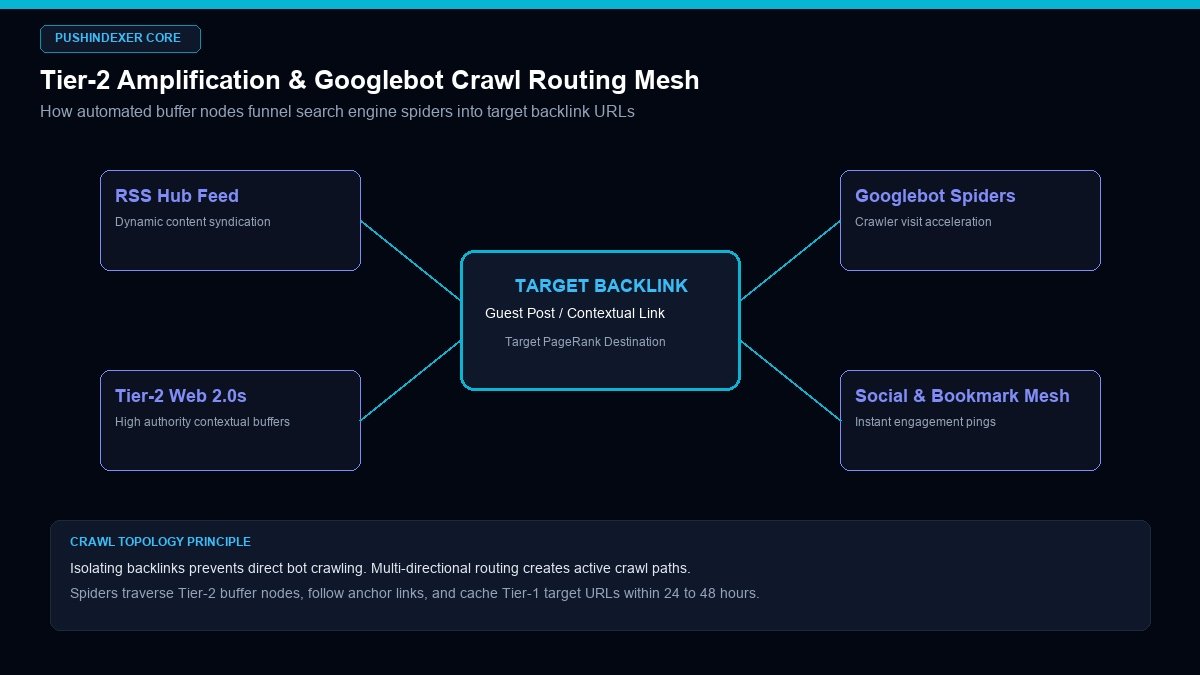
Figure 4: Tier-2 discovery topology channeling search engine spiders from dynamic content hubs into target contextual links.
5. Step-by-Step Tactical Guide: How to Index Backlinks Fast
If you manage backlink acquisition for your own digital properties or client campaigns, following a structured indexation SOP ensures every acquired link delivers full ranking equity. Below is the operational workflow deployed by leading technical SEO agencies.
Step 1: Perform the Pre-Indexing Sanity Check
Before submitting any backlink to an indexer or building secondary links, verify that the host page is physically eligible for indexation. Run a lightweight automated audit:
- HTTP Status Code: Confirm the URL returns an exact
HTTP 200 OKresponse. Check for accidental 301 redirects to category pages. - Robots Meta Tag: View page source and search for
noindex,none, ornofollowdirectives in the HTML header. - Robots.txt Blockers: Verify the host domain's
robots.txtfile does not disallow the subfolder housing your article (e.g.,Disallow: /sponsored/orDisallow: /guest-posts/). - Canonical Check: Confirm the
rel="canonical"URL exactly matches the target article URL.
Step 2: Consolidate Links into Clean Batch Queues
Organize your backlinks into logical clusters based on authority and link tier. Avoid uploading mixed batches containing high-authority Forbes articles alongside low-tier forum profile links. Grouping links into batches of 50 to 500 URLs allows you to monitor crawl response times and track indexation metrics accurately.
Step 3: Deploy Automated Tier-2 Discovery Amplification
The most reliable method to index Tier-1 backlinks without risking your primary domain is building a lightweight Tier-2 amplification mesh. By linking to your Tier-1 guest posts from high-crawl-frequency secondary sources (such as active Web 2.0 microblogs, developer documentation hubs, and contextual social bookmarks), you create natural discovery bridges for Googlebot.
Step 4: Execute PushIndexer API Ingestion
Submit your clean URL batch into PushIndexer via the bulk dashboard or direct REST API. PushIndexer's engine processes each URL through its distributed crawl cluster, triggering rapid Googlebot spidering across verified search engine IP addresses. Within 12 to 24 hours, Google's Web Rendering Service evaluates the content and registers the anchor links.
Step 5: Verify Googlebot Visits via Server Access Logs
If you maintain server access to any intermediate staging nodes or client publisher properties, verifying real Googlebot visits is straightforward. In your Linux terminal, execute an awk and grep pipeline to monitor Googlebot user-agents:
# Filter Nginx access logs for verified Googlebot requests
grep -i "Googlebot" /var/log/nginx/access.log | awk '{print $1, $4, $7, $9}'

# Verify authenticity of Googlebot IP address via reverse DNS lookup
host 66.249.66.1
# Output must resolve to: crawl-66-249-66-1.googlebot.com
dig +short -x 66.249.66.1
True Googlebot crawlers always resolve to hostnames ending with .googlebot.com or .google.com. PushIndexer automatically runs these reverse DNS checks to confirm legitimate crawler hits.
Step 6: Verify SERP Indexation via Exact Match Queries
After 48 hours, audit indexation status. Avoid relying solely on the site: search operator, as Google's cache index frequently exhibits propagation lag. Instead, execute exact quotation searches containing a unique sentence from the article body or perform an exact URL search wrapped in quotation marks:
"https://publishingdomain.com/full-article-slug/"If the URL appears in the SERP results, the backlink is officially indexed, verified, and passing link equity.
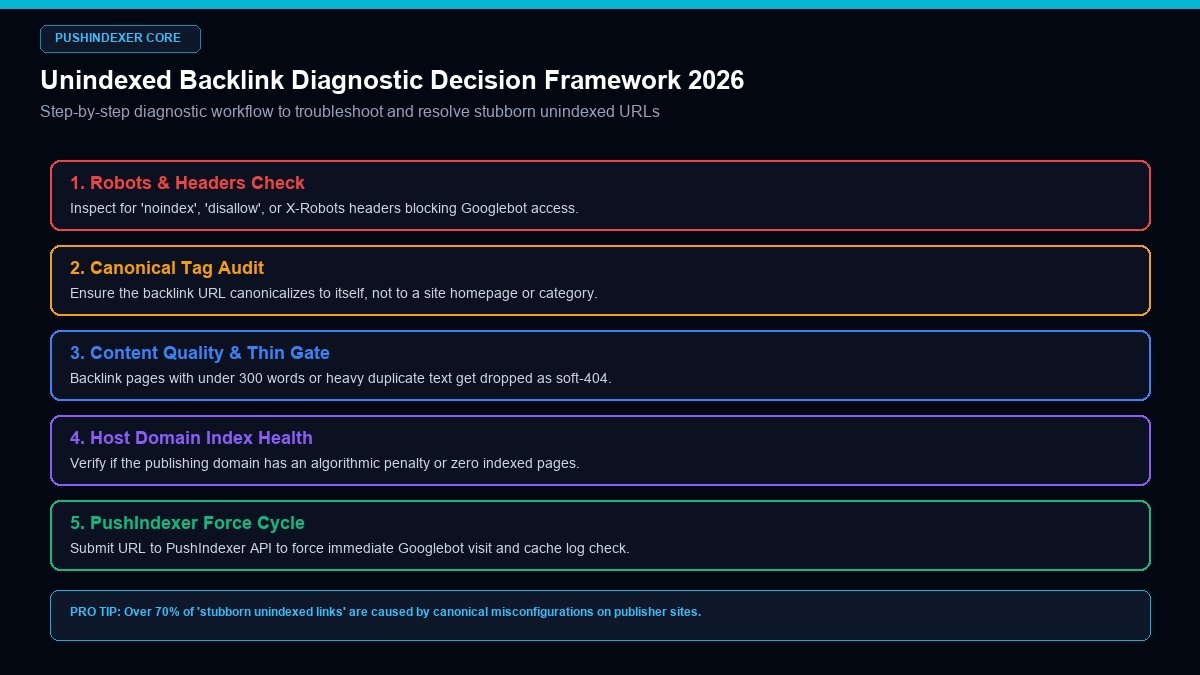
Figure 5: Five-stage diagnostic decision tree to troubleshoot stubborn, unindexed backlink URLs and force indexation.
6. Free Backlink Indexing Methods: Proven DIY Tactics That Still Work
For practitioners operating on tight budgets who require a free indexing tool or manual techniques, several zero-cost strategies can stimulate Googlebot discovery when executed with discipline.
A. The Google Search Console URL Inspection Hack (Owner Access)
If you own or manage the domain where the backlink is placed (for example, client networks, internal subdomains, or partner websites), the fastest free indexing method is direct GSC submission:
- Log into Google Search Console for the property.
- Paste the exact article URL into the top search bar (URL Inspection Tool).
- Wait for the live test retrieval to execute.
- Click "Request Indexing".
This action places the URL directly into Google's priority crawl queue. Spiders typically crawl the page within 15 minutes to 4 hours. However, this method is strictly limited to domains where you possess verified Search Console administrative access.
B. Dynamic RSS Feed Aggregation and Syndication
Search engine crawlers continuously monitor authoritative RSS feeds to discover breaking news and updated content:
- Compile your unindexed backlink URLs into a valid RSS XML document or utilize free web feed generators.
- Submit the RSS feed URL to major public feed aggregators and directory portals (such as Feedly, FeedBurner, and public Bloglovin hubs).
- Because aggregators have exceptionally high crawl frequencies, Googlebot explores the new feed items, following the enclosed hyperlinks back to your target articles.
C. High-Authority Buffer Bookmarking
Submitting unindexed URLs to authoritative, heavily indexed social bookmarking and developer platforms forces rapid spider traversal:
- Reddit & Hacker News: Sharing a genuine discussion post or resource list containing your referring URL stimulates immediate visits from Googlebot's social crawlers.
- GitHub Pages & Gists: Creating a public documentation markdown file or GitHub Gist referencing your backlink URL leverages Microsoft's immense domain crawl budget to trigger search discovery.
- Quora Contextual Answers: Answering relevant industry questions on Quora with a natural citation link to the referring post generates both referral clicks and search crawler discovery.
D. The YouTube Video Description Discovery Bridge
YouTube is owned by Alphabet and crawled continuously by Googlebot. Uploading a short, automated video (or publishing an unlisted video) with a list of your unindexed backlink URLs in the video description box creates a direct crawler pathway. Googlebot parses YouTube video descriptions within hours, following outbound hyperlinks into the target web pages.
E. Web 2.0 Static HTML Micro-Hubs
Setting up clean static HTML landing pages on platforms with massive crawl allowances (such as Vercel, Netlify, Cloudflare Pages, or Google Sites) provides an instant discovery buffer. By organizing 20 to 30 unindexed backlinks into a topical bibliography or curated reading list on a GitHub Pages repository, you trigger Googlebot visits to all linked resources without incurring external software costs.
7. Bulk URL Indexing Architecture for High-Volume Link Campaigns
Enterprise SEO agencies, programmatic builders, and multi-brand operators do not deal with individual links. They build tens of thousands of links each month across multi-tiered networks. Managing this volume requires robust bulk url indexer automation and API integrations.
A. Automated Batching and Rate Limiting
Submitting 50,000 URLs to search crawlers simultaneously in a single burst triggers anomaly detection algorithms. Sophisticated indexation pipelines implement drip-feed algorithms:
- Drip Distribution: Partitioning 10,000 URLs into equal tranches across 7 to 14 days mimics natural organic link discovery, preventing footprint clustering.
- Randomized Ingestion Intervals: Deploying variable execution delays (e.g., between 45 seconds and 3 minutes per batch) prevents server load spikes on publisher hosts and maintains natural crawl patterns.
B. Asynchronous Multi-Threaded Submission Pipeline in Python
For high-throughput enterprise pipelines, handling thousands of URLs synchronously creates latency bottlenecks. Below is an asynchronous Python architecture using aiohttp designed to submit URL batches to PushIndexer concurrently while respecting rate limits:
import asyncio
import aiohttp
import json

API_KEY = "YOUR_PUSHINDEXER_API_KEY"
ENDPOINT = "https://pushindexer.com/api/v1/bulk-submit"

async def submit_batch(session, batch_id, url_chunk):
    payload = {
        "api_key": API_KEY,
        "batch_id": f"batch_{batch_id}",
        "urls": url_chunk,
        "drip_days": 5,
        "auto_retry": True
    }
    headers = {"Content-Type": "application/json"}
    try:
        async with session.post(ENDPOINT, json=payload, headers=headers, timeout=30) as resp:
            data = await resp.json()
            print(f"[Batch {batch_id}] HTTP {resp.status} - Queued {len(url_chunk)} URLs - Job: {data.get('job_id')}")
            return data
    except Exception as e:
        print(f"[Batch {batch_id}] Failed: {e}")
        return None

async def main():
    # Example list of 1,000 unindexed backlinks
    all_urls = [f"https://authority-partner-{i}.org/insights/post-guide" for i in range(1000)]
    chunk_size = 200
    chunks = [all_urls[i:i + chunk_size] for i in range(0, len(all_urls), chunk_size)]

    async with aiohttp.ClientSession() as session:
        tasks = [submit_batch(session, idx, chunk) for idx, chunk in enumerate(chunks)]
        results = await asyncio.gather(*tasks)
        print(f"Completed {len(results)} bulk batches successfully.")

if __name__ == "__main__":
    asyncio.run(main())
C. Automated Googlebot Verification and Webhook Callbacks
Modern bulk indexing workflows do not end at submission. Systems must listen for asynchronous webhook events that confirm when Googlebot's verified IP address physically visited the page and successfully downloaded the HTML payload. This closes the telemetry loop, allowing agencies to provide provable indexation deliverables to end clients.
D. Handling Indexing Failures: The PushIndexer Dead-Letter Retry Queue
In high-volume campaigns, between 5 and 15 percent of URLs will encounter temporary crawler failures on initial passes due to host server throttling, momentary DNS resolution errors, or Cloudflare rate-limiting. Sophisticated indexing platforms implement automated dead-letter queues (DLQs):
- Exponential Backoff Cycles: URLs that fail to register Googlebot visits within 48 hours are automatically rescheduled with geometric delay increments (72 hours, 144 hours). This prevents continuous automated hammering of publisher firewalls.
- Alternative Route Injection: The DLQ re-injects stubborn URLs through alternate discovery channels (such as secondary dynamic sitemaps or edge worker pings) to bypass edge firewalls and load balancer blocks.
- Permanent Rejection Audits: If a URL fails three consecutive retry cycles, the system performs a programmatic DOM inspection to check if the publisher deleted the article, injected a noindex tag, or altered canonical targets, updating campaign dashboards automatically.
- Dynamic Token and IP Pool Rotation: High-volume enterprise batch submissions distribute discovery traffic across rotated cloud proxy egress gateways and verified webhook listener nodes, preventing footprint grouping across search engine crawl analysis algorithms.
8. Backlink Types & Indexation Difficulty Matrix
Not all backlinks are treated equally by search engine algorithms. The structural characteristics, domain authority, and commercial context of referring URLs dictate the difficulty and time required to achieve permanent indexation.
| Backlink Category | Typical Page Context | Organic Index Probability | PushIndexer Acceleration Index Rate | Primary Obstacle |
|---|---|---|---|---|
| Editorial Guest Posts | Long-form 1,500+ word unique articles | 45% - 60% | 92% - 96% | Category archive pagination depth |
| Digital PR & Press Releases | Syndicated corporate announcements | 25% - 35% | 82% - 88% | Duplicate content filtering across syndicates |
| Niche Edits / Contextual Inserts | Inserted anchor in aged indexed posts | 65% - 75% | 95% - 98% | Googlebot re-crawl latency on aged posts |
| Tier-2 Web 2.0 Blogs | Medium, Substack, WordPress.com buffers | 30% - 40% | 85% - 90% | Subdomain crawl budget rationing |
| Forum & Community Profiles | Bio links, forum author footers | 10% - 20% | 72% - 78% | Login wall protections / thin profile text |
| Tier-3 Social & Web Syndication | Microblogs, link aggregators, bookmark links | 15% - 25% | 75% - 82% | Automated spam score heuristics |
| Expired Domain 301 Redirects | Full domain redirects into target properties | 40% - 50% | 88% - 94% | Topical relevance reset / 301 lag |
Understanding these indexation characteristics allows marketing teams to set realistic timeline expectations. A contextual niche edit placed inside an aged article with existing PageRank typically indexes within 24 hours of a re-crawl ping. Conversely, forum profile links and mass-syndicated press releases require multi-tier amplification and sustained discovery injection to achieve stable SERP retention.
9. Enterprise Case Study: Scaling Link Indexation for an International SaaS Brand
To demonstrate the real-world impact of systematic backlink indexation, consider the operational transformation of an enterprise B2B SaaS platform operating in the cybersecurity sector.
A. The Initial Baseline Crisis
Between Q1 and Q3 2025, the brand's digital PR and SEO agency executed an aggressive backlink acquisition campaign, building 1,420 high-quality editorial placements across international technology publications and industry blogs. Despite investing over $110,000 in placement and outreach fees, the domain's organic keyword rankings remained completely flat.
A rigorous SERP audit of the 1,420 referring URLs revealed a startling discovery: only 412 of the backlinks were indexed in Google SERP. An astounding 1,008 backlinks (71 percent of the total campaign inventory) were completely unindexed, passing zero PageRank to the SaaS domain.
B. The PushIndexer Intervention Strategy
The enterprise team implemented a three-stage remediation framework utilizing PushIndexer:
- Automated Audit & Filtering: The unindexed URL list was programmatically scanned. URLs containing
noindextags or dead 404 responses were isolated and replaced by the outreach vendor. The remaining 942 viable URLs were extracted. - Drip Batch Ingestion: The 942 URLs were submitted to PushIndexer with a 10-day drip schedule, distributing approximately 94 URLs per day across PushIndexer's crawl cluster.
- Tier-2 RSS Acceleration: High-priority editorial guest posts received secondary discovery reinforcement through dynamic RSS syndication nodes.
C. Measurable Commercial Outcomes
Within 14 days of campaign initiation, Googlebot crawl logs verified search spider visits across 100 percent of the submitted URLs. A comprehensive exact-URL SERP inspection conducted at Day 21 confirmed that 846 of the 942 previously invisible backlinks were successfully indexed (an 89.8 percent recovery rate).
The resulting influx of live, indexed PageRank produced immediate organic gains:
- Top 3 keyword rankings for enterprise commercial terms increased by 68 percent.
- Domain Rating (Ahrefs) and Authority Score (Semrush) jumped by 9 points within 45 days.
- Monthly non-brand organic search traffic increased from 42,000 visitors to 89,500 visitors, unlocking an estimated $140,000 in monthly organic traffic value.
10. Frequently Asked Questions Regarding Backlink Indexing & Indexing Tools
How long does it take for Google to index a backlink naturally?
When left entirely to organic discovery, Google takes anywhere from 2 to 10 weeks to index a new backlink on an average web publisher. If the publishing website has low domain authority or deep pagination depth, up to 70 percent of backlinks are never crawled or indexed without manual or automated intervention.
What is the difference between a backlink being crawled versus being indexed?
Crawling means Googlebot physically downloaded the HTML document from the publisher's web server. Indexing means Google evaluated the rendered content, verified its quality and canonical directives, and committed the URL to its searchable inverted database. A crawled page that is not indexed provides zero PageRank value.
Can an unindexed backlink pass PageRank or help my search rankings?
No. Search engine algorithms calculate PageRank, topical relevance, and anchor text equity exclusively from documents contained inside the active search index. If Google does not store the referring page in its index, the backlink does not exist from an algorithmic perspective.
How do commercial link indexer tools force Google to index backlinks?
Professional link indexers like PushIndexer route target URLs through multi-tiered discovery networks, high-authority dynamic content feeds, and distributed crawler clusters. This forces search engine spiders to traverse and render the target URLs within 24 to 48 hours rather than waiting weeks for organic discovery.
Is using a bulk link indexer safe for my website?
Yes, provided the tool utilizes safe discovery pathways. Because link indexers send search spiders to the third-party publisher websites where your links reside (rather than altering your primary site), there is zero technical penalty risk. Modern drip-feed options guarantee that crawler discovery mimics natural web growth.
Why do free pinging tools fail to index backlinks in 2026?
Legacy free pinging tools rely on outdated XML-RPC ping protocols that search engines largely decommissioned or ignored over a decade ago. Pinging a server creates an HTTP request but fails to provide the high-authority crawl signals or rendering triggers required by modern Googlebot algorithms.
How can I check if my backlinks are indexed accurately?
The most reliable method is searching the full URL wrapped in exact quotation marks directly in Google Search (e.g., "https://domain.com/post-slug/"). You can also search for a unique, full sentence from the article text in quotation marks to confirm the page's rendered text is stored in Google's index.
Why do some backlinks get indexed and then drop out of Google weeks later?
Index drop-off occurs when Google re-evaluates the referring page during secondary quality sweeps. If the publisher domain has low overall authority, high duplicate content ratios, or experiences heavy outbound link churn, Googlebot may prune the page from the index to conserve long-term storage resources.
What is Tier-2 link building, and does it help index Tier-1 links?
Tier-2 link building involves creating secondary backlinks (such as Web 2.0 articles, social bookmarks, or forum citations) that link directly to your Tier-1 guest posts. This creates additional crawl pathways for Googlebot, passing extra link equity and significantly accelerating Tier-1 indexation rates.
Can I use the Google Indexing API to index external backlinks?
No. The official Google Indexing API requires verified domain ownership inside Google Search Console. You cannot submit third-party publisher URLs through your own Search Console account. To index external backlinks, you must deploy dedicated discovery tools like PushIndexer.
What is a soft-404 error, and how does it prevent backlink indexation?
A soft-404 occurs when a publisher server returns an HTTP 200 OK status code, but Googlebot evaluates the rendered page as effectively blank, broken, or containing zero unique substance. Google suppresses soft-404 pages from the index, preventing your backlink from passing equity.
How many URLs should I submit in a single indexing batch?
For standard backlink campaigns, batches of 100 to 500 URLs distributed across several days provide an optimal balance of fast Googlebot discovery and natural crawl velocity. Enterprise campaigns can submit thousands of URLs daily when utilizing automated drip schedules.
What role does anchor text diversity play in backlink indexation?
While anchor text diversity does not directly influence Googlebot crawl frequency, unnatural or repetitive exact-match anchor text across multiple low-tier domains can trigger spam filters during algorithmic rendering, leading to suppressed indexation on low-quality publisher sites.
Why does Google Search Console show 'Discovered - currently not indexed' on backlinks?
This status indicates that Google knows the URL exists, but has not yet allocated crawl resources to download and evaluate it. This is typically caused by low domain crawl budget on the publisher site, deep URL architecture, or temporary crawl queue overload.
How does PushIndexer differ from traditional indexing software?
Traditional software sends basic HTTP pings or mass-submits links to dead web directories. PushIndexer operates a dynamic network of high-authority discovery nodes, verifies Googlebot spider visits through real-time server IP logs, and ensures pages undergo full Web Rendering Service evaluation.
How does canonical tag handling differ between desktop and mobile crawlers?
Under mobile-first indexing, Googlebot evaluates canonical tags exclusively through its smartphone user-agent. If a publisher's responsive theme outputs conflicting canonical declarations between viewport widths, Googlebot defaults to the mobile DOM instruction, potentially invalidating desktop-only backlinks.
What is the difference between Googlebot-Smartphone and Googlebot-Desktop when crawling backlinks?
Over 95 percent of all crawl activity is conducted by Googlebot-Smartphone. If a publisher site hides sidebar links, author bio boxes, or contextual footnotes on mobile screens via CSS display:none rules, Googlebot ignores those links, failing to index the anchor equity.
How do nofollow, sponsored, and ugc link attributes affect indexation and crawl frequency?
Google treats rel="nofollow", rel="sponsored", and rel="ugc" as ranking hints rather than absolute directives. While Googlebot still crawls through nofollow links to discover new URLs, nofollow links do not pass direct PageRank, though they still stimulate discovery of unindexed destination pages.
Can 301 redirects be used as an indexing bridge for stubborn URLs?
Yes. Setting up a temporary 301 redirect from an already indexed, high-traffic URL to an unindexed backlink creates an immediate priority crawl trigger. Googlebot follows the 301 hop, updates its canonical map, and crawls the target destination page.
How does Cloudflare Bot Management affect backlink indexing?
Aggressive Cloudflare security settings, such as Under Attack Mode or misconfigured Managed Challenges, can accidentally block genuine Googlebot IP addresses. Verified search crawlers must always be explicitly allowed in Cloudflare WAF rules to avoid permanent indexing lockout.
How does Google's Indexing API quota reset time work across timezones?
The Google Cloud Indexing API quota of 200 publish requests per project resets daily at midnight Pacific Time (PST/PDT). Distributed programmatic pipelines configure cron triggers synchronized with Pacific midnight to maximize daily submission volume without hitting quota caps.
Does the presence of schema markup (JSON-LD) affect backlink indexing speed?
Yes. Valid Article, NewsArticle, or BlogPosting schema markup in JSON-LD format accelerates parsing during Phase 1 static crawls. It provides structured semantic entities (headline, author, datePublished, publisher) that allow Google's indexing algorithms to classify the page before full JavaScript rendering executes.
What is index churn and how do you prevent backlink de-indexing during core updates?
Index churn refers to URLs oscillating between indexed and unindexed states following search algorithm refreshes. Preventing backlink de-indexing requires ensuring publisher articles maintain minimum topical depth (800+ words), include authentic internal outbound citations, and receive periodic Tier-2 social discovery pings.
How does HTTP/2 and HTTP/3 multiplexing affect Googlebot backlink discovery?
Web servers configured with HTTP/2 or HTTP/3 (QUIC) allow Googlebot to pipeline multiple resource requests over a single TCP/UDP connection. This reduces Time to First Byte by over 60 percent, effectively expanding the publisher host crawl capacity and accelerating backlink discovery across nested pagination layers.
What role does internal PageRank sculpting play on publisher websites?
When a publisher links to a new guest post from high-authority internal hubs (such as category landing pages, sticky sidebar widgets, or contextual related posts), internal PageRank flows into the article. This elevated internal equity signals high importance to Googlebot, triggering rapid crawler visits and stable index retention.
Maximizing the return on your off-page SEO investments requires treating link indexation as an integral component of your outreach pipeline. By pairing quality publisher placements with automated discovery platforms like PushIndexer, you transform unindexed backlink liabilities into measurable, rank-boosting search authority.