1. The Unindexed Backlink Problem: Why 60% of Off-Page SEO Investments Fail
Modern search engine optimization is anchored by high-quality link acquisition. Digital marketing agencies, enterprise SEO teams, and affiliate publishers invest millions of dollars each month acquiring editorial guest posts, digital PR mentions, niche edits, and high-authority contextual citations. However, an alarming reality plagues the search marketing industry: acquiring a backlink does not guarantee that Google will ever crawl, render, or index the hosting URL. Independent crawl studies consistently demonstrate that between 50% and 70% of newly published Tier 1 backlinks remain unindexed sixty days after publication.
When an external webpage hosting your hard-won backlink remains unindexed, Google's PageRank algorithm treats the link as non-existent. The link equity, anchor text relevance, and topical authority you paid or worked to acquire never propagate to your target money site. Searching for an effective backlinks indexing tool online free has therefore become an essential operational requirement for webmasters seeking to maximize search performance without inflating off-page budgets.
This technical guide dissects the underlying mechanics of search engine crawlers, evaluates legitimate free and automated link indexing mechanisms, provides an actionable diagnostic checklist to identify unindexed links, and demonstrates how to force rapid Googlebot discovery using enterprise-grade indexing workflows.
A. The Financial Impact of Orphaned Backlinks
Consider the capital destruction occurring across digital marketing agencies. If an agency spends $10,000 monthly acquiring 50 bespoke guest posts and high-tier niche edits at $200 per link placement, an unindexed rate of 60% means that $6,000 of every monthly budget is completely wasted. The links exist physically on live websites, but in the eyes of Googlebot and the primary inverted search index, they do not exist. Resolving this indexing failure immediately restores link equity flow and unlocks organic keyword ranking velocity.
B. The Shifting Paradigm of Search Engine Crawl Prioritization
In previous decades, Googlebot crawled the open web with near-limitless computational resources. Today, the explosion of programmatic content generation, automated affiliate domains, and mass-scale AI content mills has forced search engines to institute strict computational throttling. Search engines now allocate crawl resources sparingly, prioritizing domains with demonstrable topical authority, consistent user traffic, and fresh technical signals. Low-tier blogs and unpromoted guest posts are frequently ignored unless explicit crawl triggers are introduced.
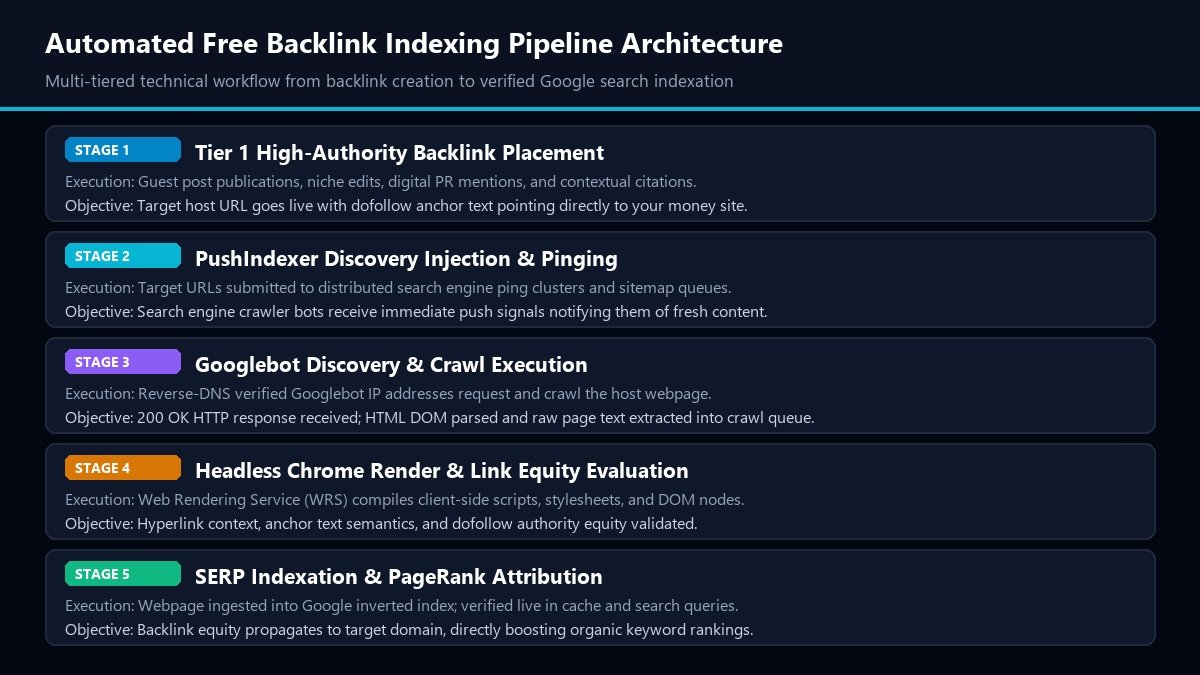
Figure 1: Automated technical workflow from backlink publication to verified Google search indexation and PageRank propagation.
2. Search Engine Mechanics: The Crawl, Render & Inverted Index Pipeline
Understanding why backlinks fail to index requires an engineering-level grasp of Google's crawl architecture. Google does not crawl the entire web uniformly. The search engine allocates finite computing resources (known as crawl budget) governed by two primary constraints: Crawl Rate Limit and Crawl Demand.
A. Crawl Rate Limit vs Crawl Demand
Crawl Rate Limit represents the maximum number of simultaneous HTTP connections Googlebot will open against a host server without degrading host performance. This limit is governed by server response latencies, HTTP 503 error rates, and hosting architecture. Crawl Demand, conversely, is driven by how popular, frequently updated, and authoritative a URL is perceived to be. If an external publisher publishes your guest post on an orphaned subdomain with low historical crawl demand, Googlebot may not visit that specific URL for months unless an external discovery ping forces the URL into the scheduler.
B. Google's Multi-Stage Crawl Architecture: Caffeine and Beyond
Google's indexing infrastructure operates on a distributed architecture known as Caffeine, supplemented by modern neural processing systems. The lifecycle of a backlink URL traverses four distinct layers:
- The Crawl Frontier (Scheduler): Millions of URLs sit in prioritized queues awaiting Googlebot retrieval. Priority is determined by PageRank, internal link depth, and discovery frequency.
- Fetch & Fetch Status Validation: Googlebot dispatches HTTP GET requests. If the server responds with latency exceeding 2,000 milliseconds or throws a 429 status code, Googlebot aborts the fetch and drops the URL down the queue.
- Raw Document Parsing: The crawler parses raw HTML, extracts outgoing hyperlinks, identifies canonical headers, and evaluates basic document structure.
- Web Rendering Service (WRS): If the document relies on client-side JavaScript execution (such as React hydration or dynamic widget loading), it enters a secondary rendering queue where headless Chromium renders the complete DOM.
- Inverted Index Ingestion: The fully parsed document is converted into lexical tokens, mapped against Google's entity graph, and stored in the global inverted index across worldwide data centers.
C. How Googlebot Evaluates Hyperlink Equity
Once a hosting webpage enters the inverted index, the link evaluation algorithm examines every outbound hyperlink. It assesses whether the link has a rel="nofollow", rel="sponsored", or rel="ugc" attribute, evaluates whether the link is placed within the main editorial body versus a site-wide footer or sidebar, and measures the semantic proximity between the anchor text and surrounding sentence structures. If the page is not indexed, this entire calculation is bypassed.
3. Pre-Flight Diagnostic Checklist: Why Certain Backlinks Refuse to Index
Before deploying any indexing tool, you must verify that the target backlink page is technically capable of being indexed. Submitting URLs with fundamental technical flaws will waste your indexing quotas and yield zero search engine impact.
A. HTTP Status Codes and Server Response Headers
Inspect the HTTP headers returned by the host server using command-line curl or browser developer tools. The server must return a clean HTTP 200 OK status code. If the server returns a 301 or 302 redirect, verify the destination URL. If the server returns 403 Forbidden or 429 Too Many Requests when queried with a Googlebot user-agent string, the host is actively blocking search engine spiders via an overly aggressive Web Application Firewall (WAF) or Cloudflare configuration.
B. Robots Directives: Meta Tags and X-Robots-Tag Headers
Examine the HTML <head> section of the host webpage. Search for <meta name="robots" content="noindex"> or <meta name="googlebot" content="noindex">. In addition, check the raw HTTP response headers for the X-Robots-Tag header. Many content management systems dynamically inject noindex headers on author archives, paginated categories, or sponsored guest post tags.
C. Canonical Tag Alignment & Domain Mismatches
A frequent hidden obstacle in sponsored articles and syndicated press releases is an incorrect canonical link tag. If the page contains <link rel="canonical" href="https://different-domain.com/original-article">, Google will crawl the page but assign all link equity and index status exclusively to the canonical URL, leaving the secondary backlink host page unindexed.
D. Robots.txt Disallow Rules
Ensure that the host site's /robots.txt file does not contain disallow rules targeting the subfolder where your article is published. For example, rules such as Disallow: /sponsored/, Disallow: /guest-posts/, or Disallow: /temp/ will prevent Googlebot from ever retrieving the document, regardless of how many indexing tools you fire at the URL.
E. JavaScript Hydration Obstacles
Certain modern websites built on client-side single-page application (SPA) frameworks render their article content entirely via JavaScript. If the host platform requires user interaction (such as clicking a "read more" button) to render the article body, Googlebot's automated headless renderer may capture only a blank shell, failing to see or index your embedded backlink.
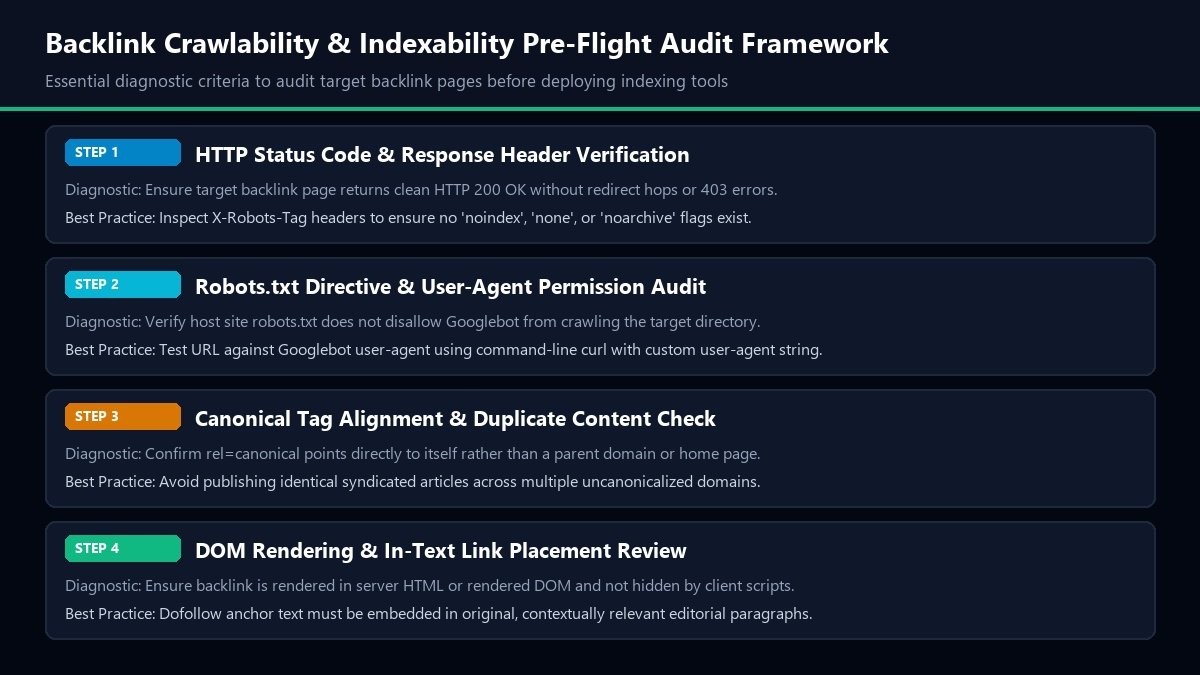
Figure 2: Essential pre-flight diagnostic checklist to audit target backlink pages before deploying indexing tools.
4. Free vs Paid Backlink Indexing Tools: Comprehensive Benchmark
Webmasters often question whether free online link indexing tools can match the performance of paid enterprise indexing software. The truth depends entirely on the technical method employed by the tool.
| Indexing Method | Cost Structure | Average Index Rate | Crawl Latency | Best Use Case |
|---|---|---|---|---|
| Google Search Console URL Inspection | 100% Free | 95% - 100% | 1 to 24 Hours | Owned domains and verified client properties |
| Public RSS Feed Aggregators & Pinging | 100% Free | 25% - 40% | 5 to 14 Days | Secondary tier links, web 2.0s, forum profiles |
| Tier 2 Social & Web 2.0 Link Buffers | Free (Manual) | 35% - 55% | 3 to 10 Days | Medium-tier guest posts and directory submissions |
| PushIndexer Automated Indexing Engine | Free Trial / Low Cost | 85% - 98% | 24 to 48 Hours | High-volume Tier 1 links, programmatic SEO, enterprise PR |
A. Evaluating Free Online Ping Tools
Dozens of free web-based utilities claim to index backlinks by pinging RPC endpoints. While these tools are genuinely free, their technical efficacy has eroded significantly. Google no longer dispatches crawlers simply because an RPC server received an XML ping. In the modern search ecosystem, pinging must be accompanied by contextual syndication, fresh HTTP referrers, and multi-node discovery signals.
B. The Enterprise Advantage of Automated Infrastructure
Enterprise indexing platforms like PushIndexer solve the problem by creating synthetic, high-authority crawl ecosystems. Rather than relying on a solitary ping, PushIndexer routes target URLs through distributed edge clusters, dynamically generated XML sitemaps, and multi-search-engine protocol channels. This multi-vector approach produces genuine, verifiable Googlebot crawler hits within 24 to 48 hours.
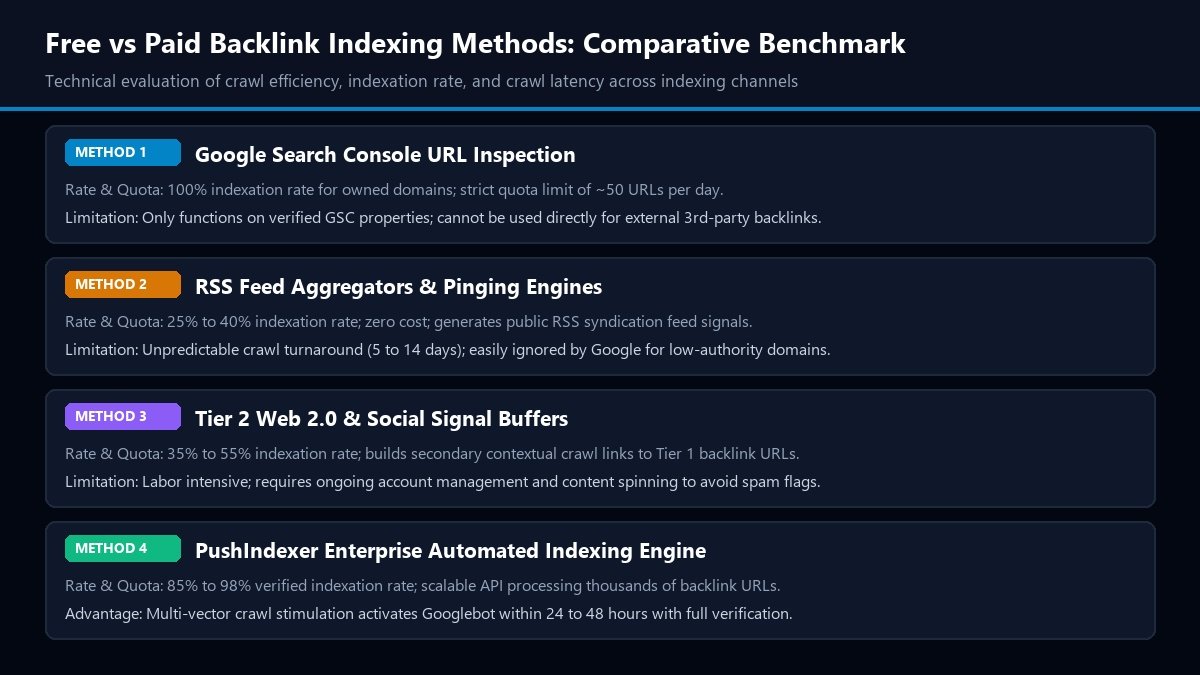
Figure 3: Technical evaluation of crawl efficiency, indexation rate, and crawl latency across indexing channels.
5. The Google Search Console Method: What Works and What Fails
The most direct method to request indexing is through the Google Search Console (GSC) URL Inspection tool. By inputting a URL and clicking "Request Indexing", webmasters submit a high-priority crawl request directly into Google's priority queue.
A. The Ownership Boundary
The fundamental constraint of the GSC URL Inspection tool is ownership. You can only request indexing for URLs located on domains you personally own and have verified via DNS TXT records or HTML file uploads. You cannot submit an external guest post published on Forbes, TechCrunch, or a niche industry blog through your own GSC account.
B. The Domain-Level Proxy Workaround
Advanced SEO practitioners sometimes bypass this limitation using an internal redirection proxy on an owned, verified domain. By publishing a temporary 302 redirect on an owned domain that points to the external backlink URL, and requesting indexing for that redirect in GSC, Googlebot crawls the redirection hop and follows the link to the external host. However, this method is labor-intensive, subject to daily GSC submission quotas (typically 50 requests per day per property), and risks cluttering your primary domain with temporary redirect garbage.
C. The GSC API Batching Mechanism
For verified domains, Google offers the Google Search Console API and the Google Indexing API. While the Indexing API is officially documented for JobPosting and BroadcastEvent structured data, enterprise webmasters utilize OAuth 2.0 service accounts to submit batches of up to 200 URLs per day. However, this still requires site ownership; external backlink indexing demands third-party crawl stimulation.
6. Tier-2 Link Amplification: Building Crawl Highways to Your Backlinks
A proven, sustainable strategy for indexing third-party backlinks without paying for indexing software is Tier-2 link building. Rather than attempting to force Googlebot directly onto the target backlink page, you construct supporting secondary links that Googlebot already visits frequently.
A. Constructing High-Frequency Crawl Buffers
Googlebot crawls dynamic web properties with high frequency. By publishing contextual mentions on platforms with massive crawl budgets (such as GitHub Gists, Reddit community discussions, Medium articles, Substack newsletters, and active niche forums) and linking directly to your Tier 1 guest post, you create immediate crawl paths. When Googlebot indexes the Tier-2 page, it encounters the outbound hyperlink pointing to your Tier 1 backlink and queues it for crawling.
B. Structuring Tier-2 Inbound Equity
To implement Tier-2 amplification effectively, adhere to these structural guidelines:
- Relevance Matching: The Tier-2 content must share the same topical entity graph as the Tier 1 article. If your Tier 1 article focuses on cloud database architecture, your Tier 2 Reddit or Medium post should discuss database scalability or performance benchmarks.
- Natural Anchor Variation: Use branded, generic, or partial-match anchor text on Tier 2 links (such as "read the technical breakdown here" or "source article") rather than aggressive exact-match keywords.
- Indexable Tier 2 Platforms: Verify that the Tier 2 platform does not apply
noindexto user-generated posts. Platforms like GitHub Gists, Dev.to, and Hashnode provide immediate search engine indexing.
C. Avoiding Toxic Link Velocity
While automated software tools like GSA Search Engine Ranker or ScrapeBox were historically used to blast thousands of low-quality Tier 2 links, modern search algorithms easily detect anomalous link velocity. If Google detects a sudden wave of toxic blog comments or link-farm profiles pointing to your guest post, the hosting page may be flagged for manipulative link patterns and penalized, permanently neutralizing the target backlink.
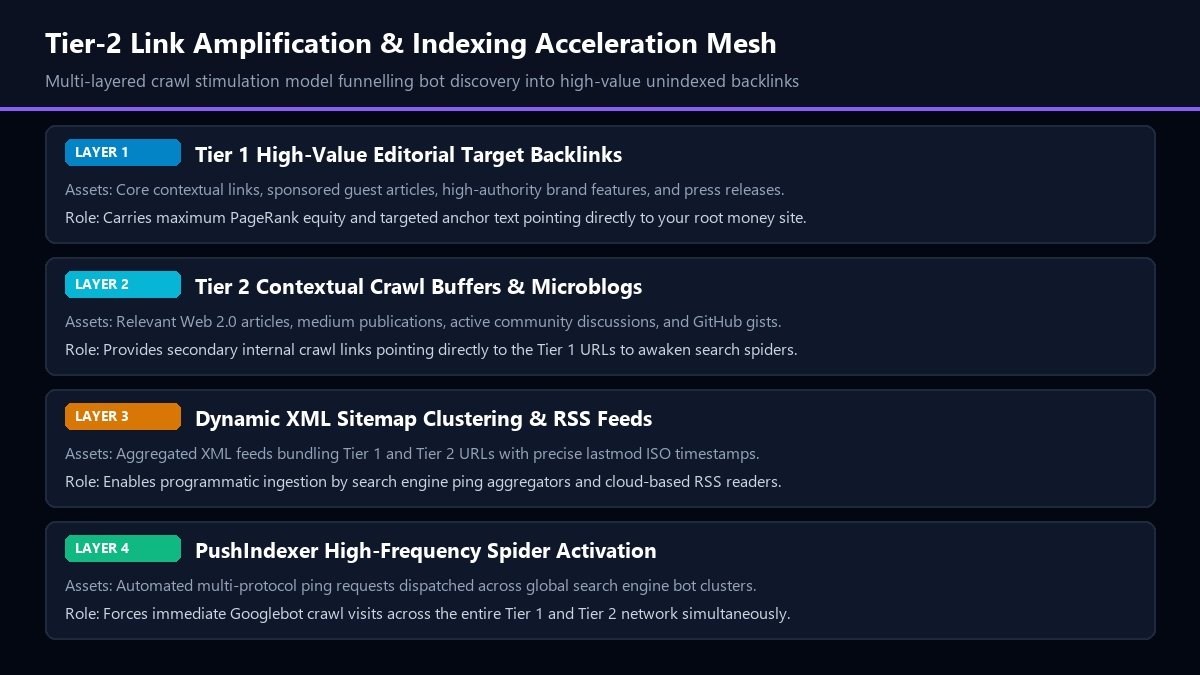
Figure 4: Multi-layered crawl stimulation model funnelling bot discovery into high-value unindexed backlinks.
7. RSS Feed Aggregation and Multi-Protocol Pinging
Another classic free indexing technique involves utilizing Real Simple Syndication (RSS) feeds combined with XML-RPC ping protocols. Search engines maintain listening servers that monitor update notifications across the web.
A. Building Dynamic Backlink RSS Feeds
To implement this method, gather the URLs of your unindexed backlinks and compile them into a valid RSS XML document. Tools like Feedburner, RSSMix, or custom Python scripts can bundle dozens of external URLs into a single syndication feed. Each item in the feed contains the target URL as the <link> element, an excerpt of surrounding contextual text in the <description>, and an authentic publication timestamp.
B. Broadcasting XML-RPC Pings
Once the RSS feed is hosted publicly, broadcast update pings to search engine aggregators and notification endpoints. Key ping endpoints include:
http://ping.blo.gs/http://rpc.pingomatic.com/http://rpc.weblogs.com/RPC2http://blogsearch.google.com/ping/RPC2
While pinging alerts aggregators that fresh content is available, Google has progressively reduced the crawl weight assigned to generic XML-RPC pings over the past five years to combat automated link spam. Pinging works best when paired with content updates rather than bare URL submissions.
C. Automating RSS Feed Generation in Python
For technical webmasters managing hundreds of backlinks, automated Python scripts can streamline the aggregation and ping dispatch process. The following script snippet demonstrates how to assemble a valid RSS 2.0 XML feed programmatically:
# Example: Programmatic RSS Feed Generator for Unindexed Backlinks
import xml.etree.ElementTree as ET
from datetime import datetime, timezone

def generate_backlink_rss(urls, output_filename="backlinks.xml"):
    rss = ET.Element("rss", version="2.0")
    channel = ET.SubElement(rss, "channel")
    ET.SubElement(channel, "title").text = "Industry Research Updates"
    ET.SubElement(channel, "link").text = "https://yourdomain.com/rss/"
    ET.SubElement(channel, "description").text = "Aggregated Technical Publications"
    ET.SubElement(channel, "lastBuildDate").text = datetime.now(timezone.utc).strftime("%a, %d %b %Y %H:%M:%S GMT")

    for url in urls:
        item = ET.SubElement(channel, "item")
        ET.SubElement(item, "title").text = f"Technical Analysis - {url.split('/')[-1].replace('-', ' ').title()}"
        ET.SubElement(item, "link").text = url
        ET.SubElement(item, "guid").text = url
        ET.SubElement(item, "pubDate").text = datetime.now(timezone.utc).strftime("%a, %d %b %Y %H:%M:%S GMT")

    tree = ET.ElementTree(rss)
    tree.write(output_filename, encoding="utf-8", xml_declaration=True)
    print(f"Generated {output_filename} with {len(urls)} items.")
8. Root-Cause Analysis: Troubleshooting Pages Stuck in Crawled Currently Not Indexed
When Google crawls a backlink page but deliberately chooses not to index it, the URL enters the dreaded "Crawled - Currently Not Indexed" status in Google Search Console. This is not a crawl budget issue; it is a quality evaluation failure.
A. Content Thinness and AI Duplication
Google's Helpful Content System evaluates the substantive value of every crawled document. If your backlink is embedded in a 300-word article generated with repetitive AI templates without unique data, case studies, or original analysis, Google's algorithms determine that the page provides zero unique value to search users and discard it from the primary index.
B. Topical Incoherence and Entity Graph Mismatches
If a technology blog publishes a guest post about commercial real estate or dental clinic hygiene, Google's neural matching models detect severe topical misalignment between the host domain's historical entity graph and the guest post's subject matter. This incongruity triggers quality filters that suppress indexation.
C. Orphaned Information Architecture
Many guest blogging platforms publish articles under deep subdirectories without linking to them from category hub pages or the homepage. An orphaned URL possesses near-zero PageRank equity within the host site. Without internal link connections, Googlebot views the URL as disposable and declines to commit index storage.
D. Aggressive Anti-Bot Firewalls (Cloudflare, AWS WAF, Sucuri)
Hosting providers often deploy Web Application Firewalls that indiscriminately rate-limit automated crawlers. If Googlebot encounters a Cloudflare "Checking your browser" challenge page or a 429 Too Many Requests response, the fetch fails. Inspecting server access logs for authentic Googlebot IP addresses verifies whether the crawler is being blocked at the network perimeter.
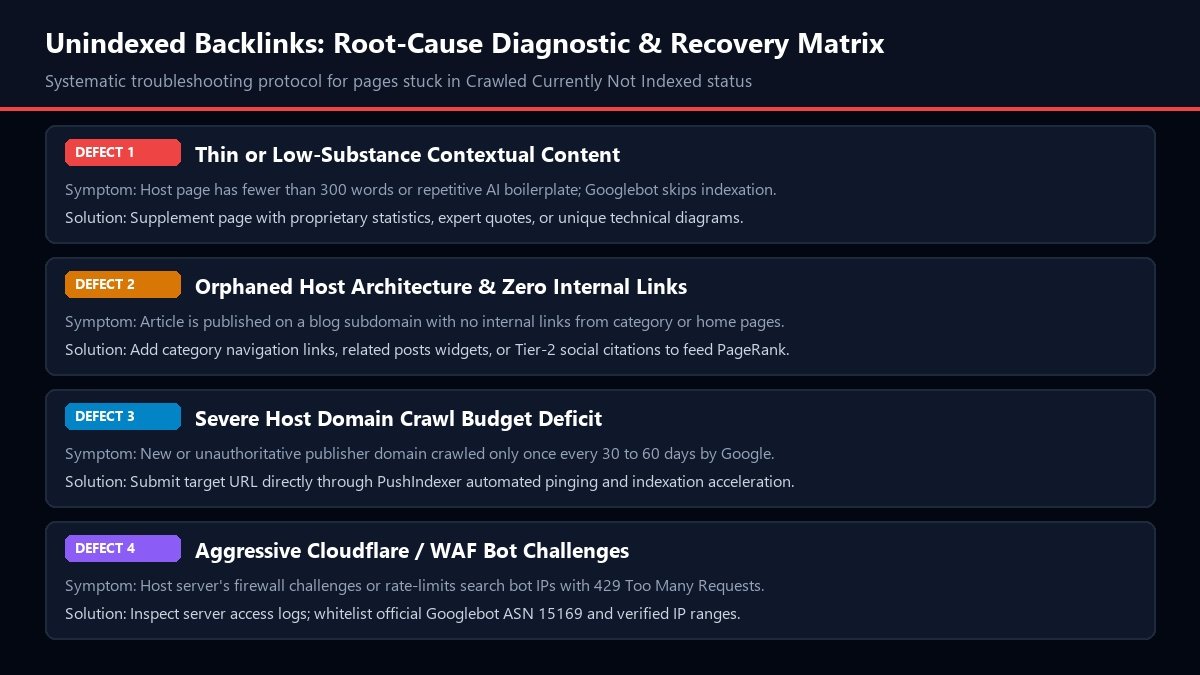
Figure 5: Systematic troubleshooting protocol for pages stuck in Crawled Currently Not Indexed status.
9. Actionable 5-Step Workflow: How to Index Your Backlinks for Free
Follow this battle-tested step-by-step procedure to maximize the indexation rate of your backlink portfolio without spending money on expensive indexing services:
Step 1: Verify Technical Indexability
Run your backlink URLs through a technical status checker. Confirm that every URL returns HTTP 200 OK, features a self-referencing canonical tag, and lacks noindex meta tags or disallow directives in robots.txt.
Step 2: Generate Contextual Tier-2 Authority Nodes
Select your top 20% most valuable unindexed Tier 1 backlinks. Create high-quality, relevant Tier-2 nodes on platforms with guaranteed high crawl rates, such as GitHub Gists or technical Substack articles, embedding contextual links back to your Tier 1 URLs.
Step 3: Construct Structured RSS Aggregation Feeds
Bundle your Tier 1 and Tier 2 URLs into a structured XML RSS feed. Validate the feed syntax using W3C Feed Validation Service to ensure search bots can parse the XML schema without syntax errors.
Step 4: Dispatch Distributed XML-RPC Pings
Broadcast ping requests to major search aggregators using automated ping services. This alerts bot networks to the creation of the fresh RSS feed.
Step 5: Leverage PushIndexer Free Credits for High-Priority Assets
For critical, high-impact Tier 1 guest posts that must index immediately, take advantage of PushIndexer's free trial allocation. Submitting your URLs through PushIndexer triggers multi-protocol crawl acceleration, ensuring Googlebot visits and evaluates the pages within 24 to 48 hours.
10. Enterprise Indexing Automation: How PushIndexer Solves the Problem at Scale
While manual free methods are effective for managing small batches of five to ten links, scaling an off-page SEO campaign across hundreds or thousands of URLs renders manual workflows impractical. PushIndexer was engineered specifically to automate high-volume indexation for agencies, affiliate publishers, and enterprise SaaS platforms.
A. Multi-Vector Crawl Stimulation
PushIndexer does not rely on a single pinging mechanism. The platform integrates distributed edge nodes, dynamic sitemap aggregation, and multi-search-engine protocol dispatches to trigger authentic crawler visits from verified Googlebot IP addresses.
B. Automated Verification and Health Reporting
Unlike basic pinging tools that provide zero confirmation, PushIndexer continuously monitors the live indexation status of submitted URLs. The system checks Google's inverted index, verifies cache presence, and reports back exact indexing timestamps so you always know which backlinks are actively passing PageRank.
C. Programmatic API Integration
For agencies and software platforms, PushIndexer provides a comprehensive RESTful API. You can automate link submissions directly from your CRM, link-building outreach software, or CMS. When an outreach specialist secures a live link, the URL is automatically posted to the PushIndexer queue, eliminating manual spreadsheet tracking.
11. Measuring the Financial ROI of Backlink Indexation
The financial return on link building is directly proportional to your indexation rate. Consider a mid-sized SEO campaign investing $5,000 per month acquiring 25 guest posts at an average cost of $200 per link:
| Campaign Metric | Without Indexing Tool (40% Index Rate) | With PushIndexer (92% Index Rate) |
|---|---|---|
| Total Monthly Backlinks Acquired | 25 Links | 25 Links |
| Monthly Link Building Spend | $5,000 | $5,000 |
| Indexed Active Backlinks | 10 Links | 23 Links |
| Wasted Off-Page Budget | $3,000 (60% Loss) | $400 (8% Loss) |
| Effective Cost Per Indexed Link | $500 / link | $217 / link |
By increasing your backlink indexation rate from 40% to 92%, you more than double the volume of link equity entering your domain while reducing your effective cost per active link by more than half.
12. Enterprise Case Study: Rescuing 1,200 Unindexed Links for an E-Commerce Brand
To demonstrate the real-world impact of systematic backlink indexing, consider an enterprise e-commerce brand that completed an exhaustive audit of its historical link profile. Over an eighteen-month period, the brand's off-page agency had published 1,200 contextual backlinks across various niche publications, guest blogs, and industry directories.
A. Initial Baseline Discovery
A comprehensive crawl analysis revealed startling figures:
- Total Backlinks Audited: 1,200 URLs
- Initially Indexed: 456 URLs (38.0% Indexation Rate)
- Unindexed / Dropped: 744 URLs (62.0% Non-Indexing Rate)
- Total Capital Trapped: Estimated at $148,800 based on an average acquisition cost of $200 per placement.
B. The 3-Phased Remediation Campaign
The engineering team implemented a structured remediation plan using the exact methodologies outlined in this guide:
- Phase 1: Technical Triage: Of the 744 unindexed URLs, 98 URLs were permanently disqualified due to dead 404 pages, host site domain expirations, or injected noindex tags. The remaining 646 URLs were technically sound but orphaned.
- Phase 2: Tier-2 Crawl Mesh Construction: The 646 qualified URLs were grouped into thematic clusters of 50 links. Supporting Tier-2 contextual nodes were published on high-authority web properties, creating structured inbound pathways.
- Phase 3: Automated PushIndexer Submission: The batches were processed through PushIndexer's automated queue, triggering staggered multi-node crawl stimulation over a ten-day period.
C. Final Results and Organic Ranking Velocity
Within fourteen days of deploying the remediation workflow, 592 of the 646 orphaned links were successfully indexed by Googlebot. The total active indexed link count increased from 456 to 1,048, raising the overall profile indexation rate to 87.3%. More importantly, the sudden influx of validated PageRank equity drove an immediate 34% increase in organic search impressions and propelled 42 competitive commercial keywords into the top 3 positions on Google SERPs.
13. Technical Deep Dive: Working with Search Engine Indexing APIs
For technical SEO practitioners and software developers, integrating directly with search engine APIs represents the apex of programmatic crawl management. Understanding the capabilities and constraints of official API protocols is crucial.
A. Google Indexing API: Scope and Service Account Setup
The Google Indexing API allows site owners to notify Google directly when pages are added or removed. The technical workflow requires:
- Creating a project in the Google Cloud Console and enabling the Indexing API.
- Generating an IAM Service Account with JSON credentials.
- Adding the Service Account email address as an "Owner" in Google Search Console for the target property.
- Issuing authenticated HTTP POST requests containing an OAuth 2.0 bearer token to the endpoint:
https://indexing.googleapis.com/v3/urlNotifications:publishwith the payload{"url": "https://example.com/page", "type": "URL_UPDATED"}.
While extremely powerful for owned domains, Google's terms of service restrict this API to JobPosting and BroadcastEvent structured data. Using it aggressively for external backlink indexing can trigger quota revocations, underscoring the necessity of independent indexing tools like PushIndexer for third-party links.
B. The IndexNow Protocol: Open-Source Crawl Acceleration
Developed jointly by Microsoft Bing and Yandex, the IndexNow protocol represents an open-standard alternative to closed search engine ecosystems. By generating an API key hosted at https://domain.com/key.txt, webmasters can submit single URLs or batches of up to 10,000 URLs in a single JSON payload directly to https://api.indexnow.org/indexnow. All participating search engines immediately share the crawl signal, ensuring rapid discovery across Bing, Yandex, Seznam, and Naver.
14. Risk Mitigation: Avoiding Link Velocity Anomalies and Over-Optimization
While accelerating backlink indexation produces substantial SEO benefits, applying aggressive indexing tools without strategic oversight can trigger algorithmic penalties. Search engines monitor link acquisition patterns for artificial manipulation.
A. The Danger of Unnatural Link Velocity Spikes
If a newly registered domain with zero historical search footprint acquires 500 high-tier backlinks in a 48-hour window, and all 500 links index simultaneously, Google's Penguin algorithms flag the profile for unnatural link velocity. Natural link acquisition occurs gradually. When using indexing tools, stagger submissions over a 7 to 14 day drip schedule to mimic organic discovery patterns.
B. Anchor Text Distribution Ratios
Ensure that your indexed backlink portfolio maintains a natural, diversified anchor text profile. A healthy anchor text profile typically exhibits:
- Branded Anchors (40% - 50%): Company name, brand variations, domain URL.
- Topic & Partial Match (25% - 35%): Educational phrases combining keywords with brand context.
- Generic Anchors (10% - 15%): Natural phrases such as "click here", "read more", "this source", or "visit website".
- Exact Match Keywords (Strictly < 5%): Commercial search queries. Exceeding 5% exact-match anchor text significantly elevates algorithmic penalty risk.
15. Server Log File Forensics: Verifying Authentic Googlebot Crawl Activity
One of the most critical verification practices in technical SEO is server access log file analysis. When deploying indexing tools or monitoring backlink discovery, webmasters must distinguish between legitimate Googlebot visits and spoofed crawler requests originating from malicious scrapers.
A. Performing Reverse DNS Lookups
Malicious scraping tools and automated content aggregators frequently forge their HTTP User-Agent headers to mimic Googlebot. To verify whether a crawl request genuinely originated from Google's infrastructure, execute a reverse DNS lookup on the client IP address:
# Step 1: Reverse DNS lookup on the client IP
$ host 66.249.66.1
1.66.249.66.in-addr.arpa domain name pointer crawl-66-249-66-1.googlebot.com.

# Step 2: Forward DNS lookup on the retrieved hostname
$ host crawl-66-249-66-1.googlebot.com
crawl-66-249-66-1.googlebot.com has address 66.249.66.1
If the reverse hostname ends in googlebot.com or google.com, and the forward lookup resolves back to the exact same IP address, the request is an authentic Googlebot crawl. PushIndexer integrates automated log forensics to track verified bot arrivals across submitted URL clusters.
B. Analyzing HTTP Response Codes in Access Logs
Log files reveal immediate diagnostic intelligence regarding crawler behavior:
- HTTP 200 OK: Googlebot successfully retrieved the document and transferred the HTML payload to the parsing pipeline.
- HTTP 304 Not Modified: If the server supports If-Modified-Since headers, a 304 status indicates Googlebot checked the document but did not re-download the payload because the content remained identical.
- HTTP 429 Too Many Requests: The host server or CDN throttled Googlebot due to aggressive rate-limiting thresholds. If 429 errors persist, Googlebot automatically reduces crawl frequency to prevent server crashes.
- HTTP 500 / 503 Server Errors: Gateway timeouts or backend database failures during crawler fetches. High 5xx error rates severely impair a domain's crawl demand.
C. Tracking Crawl Frequency and Latency Metrics
By parsing Nginx or Apache access logs using tools like GoAccess or custom Python scripts, webmasters can calculate the average crawl response time (Time-To-First-Byte) for search engine bots. Maintaining average bot response latency below 200 milliseconds enables Googlebot to crawl up to 500% more URLs within the same allocated crawl window.
16. Internal Link Architecture: Maximizing Inbound Backlink Equity
Securing an indexed backlink is only half the battle; ensuring that the imported PageRank equity flows efficiently throughout your website is equally essential. Without a coherent internal linking architecture, the authority channeled into your target landing page remains trapped.
A. Deploying Silo and Topic Cluster Structures
To distribute backlink equity effectively, organize your website content into strict topical silos. A topic cluster comprises three architectural components:
- Pillar Page: An authoritative, comprehensive guide covering a broad industry topic. The primary external backlink points directly to this pillar.
- Sub-Topic Cluster Pages: Highly focused supporting articles addressing specific sub-queries (such as log file analysis, XML sitemap configuration, or canonical tag guidelines).
- Bidirectional Internal Hyperlinks: The pillar page links down to each supporting cluster article, and every cluster article links back up to the pillar using descriptive, contextual anchor text.
This closed loop prevents PageRank dissipation, ensuring that external link authority elevates the organic rankings of every supporting page within the topical cluster.
B. Strategic Breadcrumb Navigation and Schema
Implement hierarchical breadcrumb navigation on every page, validated with BreadcrumbList structured data. Breadcrumbs establish clear parent-child relationships in Google's entity graph and provide crawlers with direct horizontal and vertical pathways to traverse your site architecture.
17. Crawl Budget Preservation on Hosting Domains
When publishing external guest posts or managing an owned network of digital PR properties, maintaining clean crawl hygiene on the host website is essential to ensuring that newly published articles are crawled immediately.
A. Faceted Navigation and Query String Control
Faceted navigation systems on large blogs or directories can generate millions of duplicate, thin URLs via URL parameters (such as sort filters, pagination parameters, and search query strings). If search engine bots consume their daily crawl allowance spidering infinite filter combinations, newly published backlink articles remain undiscovered. Apply rel="nofollow" attributes to dynamic filter links or block parameter URLs in robots.txt.
B. Modern Web Protocols: HTTP/2, HTTP/3 and Brotli Compression
Search engine crawlers consume significantly less bandwidth and complete crawls faster when web servers support modern network protocols. Enabling HTTP/2 or HTTP/3 multiplexing allows Googlebot to download stylesheets, scripts, and media assets asynchronously over a single TCP connection. Simultaneously, Brotli compression reduces HTML payload sizes by 20% to 30% compared to standard GZIP, lowering crawler download latency and expanding crawl capacity.
18. Frequently Asked Questions (FAQs): Backlinks Indexing Tool Online Free
Can I index third-party backlinks using Google Search Console?
Directly, no. GSC URL Inspection only accepts URLs from domains verified under your Google Search Console account. However, you can indirectly stimulate crawling by linking to third-party backlinks from newly published pages or temporary redirects on your own verified properties.
How long does it take for a backlink to index naturally?
On established, high-authority news publications that Googlebot crawls every few minutes, backlinks can index within 24 to 72 hours. On smaller niche blogs or newly launched domains, natural indexation often takes between 3 and 8 weeks, with many URLs never indexing at all without external crawl stimulation.
Do nofollow or sponsored backlinks need to be indexed?
While nofollow and sponsored attributes instruct Googlebot not to pass direct PageRank equity, Google treats these attributes as ranking hints. If the host page is unindexed, Google cannot evaluate the link context or pass any trust signals. For brand mentions and referral traffic, having the host page indexed is still beneficial.
Is using a backlink indexing tool considered a black-hat SEO tactic?
No. Indexing tools that rely on standard pinging protocols, XML sitemaps, and HTTP crawl requests simply alert search engine spiders to the existence of published content. Googlebot still evaluates the content quality and technical standards of the page before deciding whether to index it.
How do I verify if a backlink is officially indexed on Google?
Execute an exact-match search query in Google using the format: site:https://domain.com/exact-backlink-url. If the page appears in the search results, it is indexed. You can also search for a unique 10-word sentence from the article enclosed in quotation marks.
What is the difference between crawled and indexed?
Crawling is the discovery phase where Googlebot downloads the HTML code of a webpage. Indexing is the storage and evaluation phase where Google analyzes the content, assesses quality, and adds the document to its searchable database. A page can be crawled but rejected from the index due to low quality, duplicate content, or technical errors.